Is Home Office Immigration Policy Failing IT Professionals with “Cheap Labour”?

Written by Matt Collingwood, Managing Director, VIQU IT
For years, I’ve supported controlled immigration, especially in technology, an industry where real skills shortages exist. That belief has never wavered. But recently, I’ve been challenged with a pointed question… are Skilled Worker migrants undercutting UK IT professionals, by offering “cheap labour”?
It’s a fair concern. The perception is widespread that companies sponsor and relocate overseas Skilled Workers because they’re “cheaper”. If that were true, it would pose a serious problem for UK IT professionals trying to secure roles.
So, I went digging. And thanks to a Freedom of Information (FOI) request I submitted to the Home Office, the reality turned out to be very different from the assumption.
Why I’ve Always Backed Skilled Worker Immigration
For context, my IT recruitment company, VIQU IT has helped more than 130 individuals relocate to the UK via the Skilled Worker visa program. Most have been software developers from South Africa, Vietnam, and the Philippines. Every campaign was a response to genuine skill shortages.
In every case, the businesses we worked with paid the market rate and treated these professionals as equals. Sponsorship wasn’t cheaper, in fact, with multiple logistical and administrative costs, it was more expensive.
Since April 2025, the cost structure has changed and sponsoring a Skilled Worker in the UK involves several key costs. The application fee for a visa longer than 3 years is £500. The Immigration Health Surcharge (IHS) is £1,035 per year, totalling £3,105 for a 3-year visa. Employers must also pay the Immigration Skills Charge, which is £1,000 for the first year and £500 for each subsequent 6-month period, amounting to £2,000 over 3 years for medium or large sponsors.
Legal fees for visa applications typically range from £1,000 to £2,500, depending on complexity. Additional costs include the Certificate of Sponsorship (CoS) fee. In total, the estimated cost to sponsor a Skilled Worker for 3 years for a business is approximately £8,000, excluding any additional expenses, such as relocation or training costs.
How Many Migrant Workers Are Sponsored in the UK?
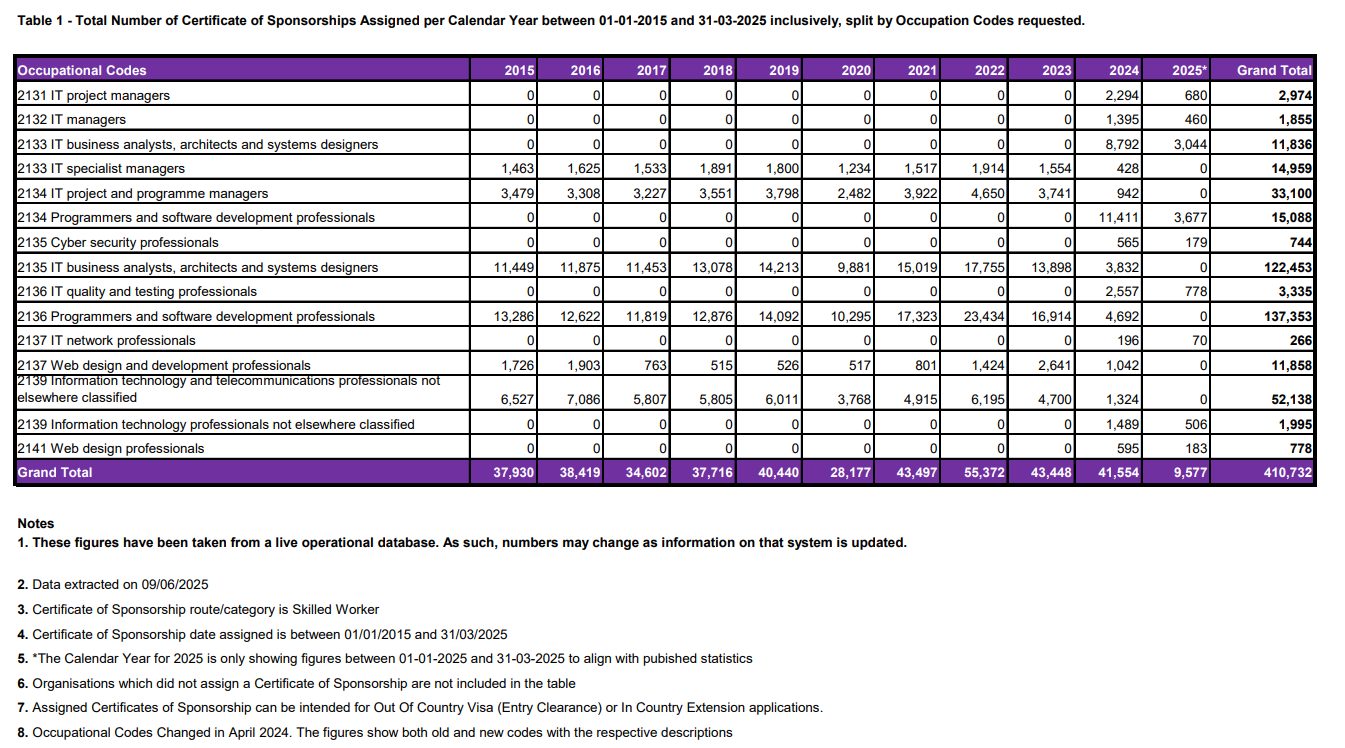
Between 2021 and 2024, a total of 183,871 IT professionals were granted Certificate of Sponsorship under the Skilled Worker Programme. Numbers increased between 2021 (43,497) and 2022 (55,372) reflecting the heights we saw in the IT market as businesses came out the other side of the unstable Covid-19 pandemic period. However, since then, we’ve seen a steady decline, with 2023 IT Skilled Worker numbers on par with 2021, and then the numbers continuing that downward trajectory, concluding in an expected decline of 36% when comparing 2022 to 2025 (2025 numbers based on data from the first 3 months of the year).
The Suspicion: Are Overseas Workers Undercutting?
A few months back, after I posted about Labour’s proposed immigration reforms on LinkedIn, an out of work IT Programme Manager replied bluntly: “Immigrants are cheaper and can undercut UK talent.”
At first glance, the logic makes sense. The Home Office’s general salary threshold for Skilled Worker visas in IT is £37,500. Compare that to the UK average IT salary of £47,500, and it looks like a structural incentive to bring in talent at lower pay.
This argument aligns neatly with the undercutting narrative. Employers save money. UK professionals lose opportunities. Everyone has heard the story.
But here’s the problem… it’s not true.
The FOI Reality: Migrants Are Paid More
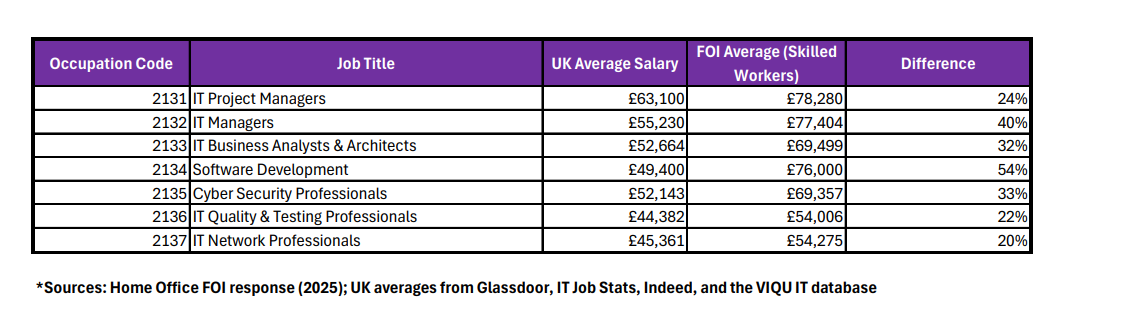
In July 2025, I filed an FOI request with the Home Office asking for average salaries paid to Skilled Workers under seven key technology occupation codes. Sponsor companies must provide salary information to the Home Office, including any increases. I then compared this with the average salaries earned by UK professionals in the same areas.
The results? Across the board, Skilled Worker migrants were paid MORE than UK workers in the same areas of technology. Yes, we don’t know the exact skills, seniority and experience levels contributing to both the UK and Skilled Worker averages, so it’s difficult to compare like for like.
However, these statistics give a clear indication that far from being a tool for wage suppression, the Skilled Worker route is being used as a premium recruitment channel for access to specialist skills, one where employers pay above market rates.
The Numbers That Tell The Story
This chart offers a salary comparison between UK-based averages and FOI-confirmed Skilled Worker salaries for 2024:
What This Means For The Debate
The numbers make it plain… the Skilled Worker visa route is not a loophole to hire cheaper labour.
Companies hiring skilled migrants are paying a premium, not just in salaries but also in visa and relocation costs. That means:
- UK IT professionals aren’t being undercut.
- The UK economy benefits from higher tax contributions from these higher salaries.
- Migrants are not a cheap alternative, they are an investment in specialist skills and knowledge.
- The Home Office’s own data exposes the undercutting narrative as a myth.
Is The UK At Risk Of Losing Needed Technical Talent From Overseas?
Overall, the trends highlight a strong dependence on overseas developers, with programmers and software developers accounting for one in three Skilled Worker visas in IT. So, should we be concerned in the steady decline we’re seeing in the total numbers of Skilled Workers?
The concern lies in the amount businesses gaining sponsorship licenses in the last 5 years (137,000+ as of Sept 2024) not corresponding with the overseas hiring numbers. Whilst some IT professionals falsely believe that the UK is welcoming more and more cheap IT labour making the jobs market difficult for them, are we all actually shooting ourselves in the foot?
Are increased costs from the Home Office making overseas Skilled Workers no longer an option for UK businesses, and the UK a less desirable working location for Skilled Workers to choose? This step backwards could take much-needed key specialist technical skills out of the UK tech market, reducing productivity, stifling innovation and transformation, and negatively affecting the UK’s economy and place as a technical leader on the world stage.
The Bottom Line
The immigration system isn’t perfect. There are questions around skill shortages, the balance between migration and domestic training, and the integrity of some employers.
But one fact is now undeniable: Skilled Worker migrants in IT are not being paid less.
So, next time someone says, “They’re cheaper”, point them to the data. The reality is far more reassuring: overseas talent isn’t undercutting UK professionals — it’s bolstering the sector while paying above-market wages.