Why Stable Teradata Workloads Cost Less – And How Teams Achieve Stability
Teradata platforms power some of the most critical analytical systems in UK enterprises, particularly in financial services, telecom, and the public sector. These environments run large-scale reporting, regulatory analytics, fraud detection, billing analytics, and operational intelligence, where performance, reliability, and predictability matter.
But there’s a factor often overlooked when discussing Teradata efficiency:
Workload stability directly affects cost, compliance, and operational risk.
Not just system performance. Not just SLAs. Actual operational cost.
Understanding this connection is becoming increasingly important as organisations modernise legacy estates while keeping Teradata as a core analytical engine.
Stability in Teradata Is About Predictable Resource Behaviour
Teradata systems are engineered for high concurrency and parallel processing. However, their efficiency depends on balanced, predictable workload patterns.
When jobs behave consistently:
- CPU usage remains within expected ranges
- I/O patterns are stable
- Data distribution across AMPs stays balanced
- Query execution plans remain efficient
When workloads become unstable, resource consumption becomes erratic. The system compensates — but at a cost.
Why Unstable Workloads Drive Higher Costs
1. Rising CPU Consumption
CPU time in Teradata is a strong indicator of system effort. When queries or jobs gradually consume more CPU:
- Execution plans may have changed
- Data volumes may have grown
- Joins may have become less efficient
Even small increases across many jobs accumulate into significant system load.
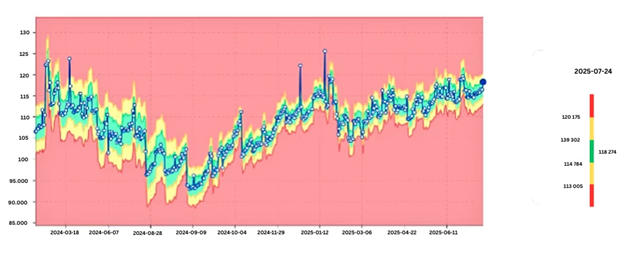
CPU consumption trend increasing for a specific job
2. I/O Spikes and Storage Pressure
Unstable queries often produce inconsistent I/O patterns:
- Larger intermediate spool
- More frequent disk access
- Increased pressure on storage subsystems
These behaviours extend runtime and reduce overall system efficiency.
3. Data Skew Across AMPs
Teradata’s parallel architecture depends on balanced data distribution.
When skew increases:
- Certain AMPs handle disproportionate workloads
- Queries take longer to complete
- System resources are underutilised elsewhere
Skew introduces variability and performance unpredictability.
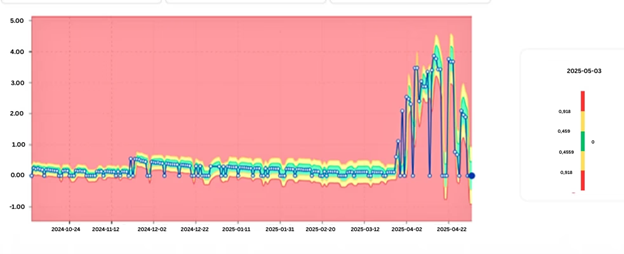
Skew detection trend
4. Volatile Query Behaviour
Jobs that once ran consistently begin to show:
- Fluctuating runtimes
- Irregular resource usage
- Unpredictable completion windows
This volatility complicates workload scheduling and capacity planning.
Stability Lowers Cost in Three Ways
1. Predictable Capacity Planning
Stable workloads allow teams to:
- Forecast CPU and I/O demand
- Avoid over-provisioning
- Reduce emergency scaling
2. Reduced Resource Waste
Consistent execution plans minimise:
- Unnecessary spool
- Excessive joins
- Repeated retries
Efficiency improves without additional hardware.
3. Lower Operational Overhead
Stable environments generate:
- Fewer incidents
- Less firefighting
- Fewer escalations
Engineering effort can shift from reactive troubleshooting to optimisation.
Why Traditional Monitoring Is Not Enough
Most Teradata monitoring focuses on:
- Query failures
- Space utilisation
- System availability
But instability often develops before any threshold is breached.
A job may:
- Still complete successfully
- Stay within space limits
- Avoid error conditions
Yet its resource behaviour may already be drifting.
The Shift Toward Behavioural Monitoring
Modern approaches analyse how workloads behave over time, not just whether they succeed.
Key signals include:
- CPU consumption trends
- I/O pattern evolution
- Skew metrics
- Runtime variance
By converting these into time-series views, teams detect drift and volatility early.
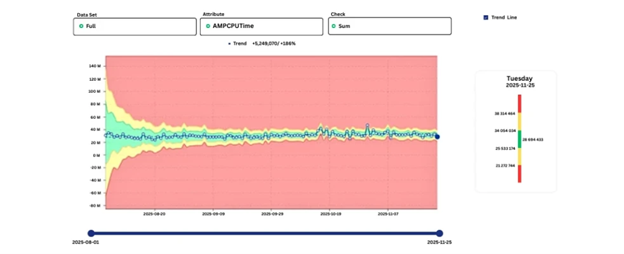
Learned normal CPU band tightening over time
Detecting Instability Before It Becomes Expensive
Spotting Gradual CPU Drift
Instead of fixed thresholds, behavioural models highlight jobs where CPU usage has increased significantly compared to historical baselines.
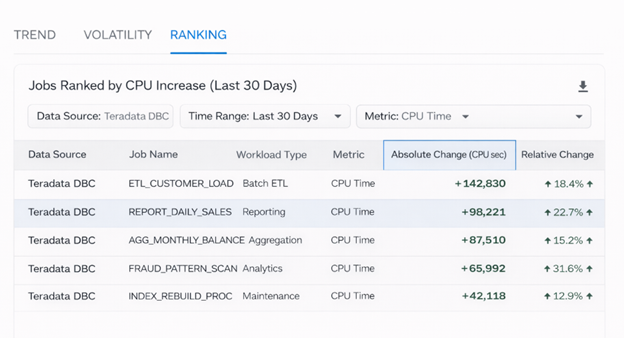
Jobs ranked by CPU increase
Identifying Unstable Queries
Queries showing rising runtime variance are often early indicators of data growth, skew, or execution plan inefficiencies.
Accounting for Seasonal Patterns
Month-end, regulatory reporting cycles, and weekly peaks create expected load changes. Modelling seasonality prevents false alarms while catching true anomalies.
Where digna Supports Stability
Solutions such as digna analyse Teradata workload metrics over time, using AI to learn normal patterns and detect deviations that suggest instability.
Rather than relying only on static thresholds, anomaly-based monitoring surfaces both sudden spikes and slow behavioural drift, helping teams address issues before costs escalate.
More about this approach can be explored here:
https://www.digna.ai/data-anomalies
Why This Matters for UK Enterprises
UK organisations operating Teradata systems face:
- Growing data volumes
- Regulatory analytics demands
- Hybrid architecture complexity
- Cost optimisation pressure
Stability becomes a strategic lever. Efficient workloads do not just run faster, they cost less, scale more predictably, and reduce operational risk.
Final Thoughts
Teradata systems rarely fail because workloads become inefficient. They absorb the pressure until costs, performance degradation, or operational strain become visible.
Organisations that monitor workload behaviour and prioritise stability gain long-term efficiency, predictability, and financial control.
Stable workloads are not just good engineering.
They are good economics.