Certes Research Reveals Most Organisations Are Unprepared for Quantum Security Threats
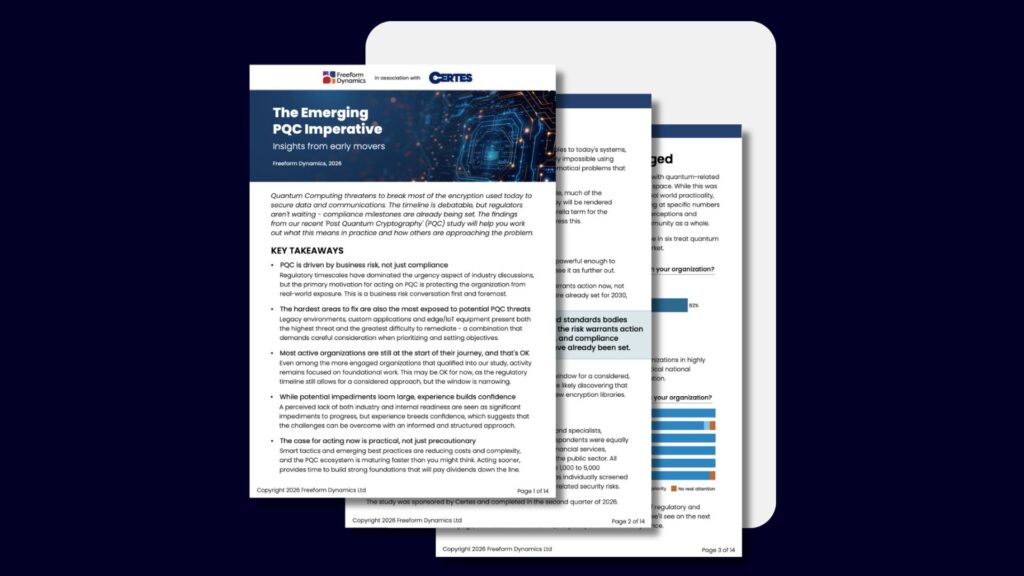
Certes has published new research highlighting growing concerns around quantum security readiness, with most organisations admitting they are not prepared for the transition to post-quantum cryptography.
According to the company’s Emerging PQC Imperative report, 78% of organisations believe legacy systems represent their biggest quantum security risk. Many of these environments are difficult to modernise or secure, leaving sensitive data vulnerable as quantum computing capabilities continue to develop.
The research, carried out by Freeform Dynamics and commissioned by Certes, surveyed 200 senior IT and security decision-makers across the UK and the US, including CISOs, CIOs, and technology leaders from sectors such as healthcare, financial services, manufacturing, and the public sector.
Confidence in quantum readiness remains low
Despite widespread awareness of the risks posed by quantum computing, the report found that very few organisations feel prepared to deal with the challenge.
Only 11% of respondents said they are confident they can achieve post-quantum readiness within expected timelines, while just 2% said they are fully confident in their ability to achieve crypto agility at scale.
The findings suggest many businesses are still struggling to move beyond planning stages and implement meaningful protections.
Paul German, CEO of Certes, said organisations understand the threat but are finding it difficult to take practical action.
“Most security and IT leaders understand the threat quantum computing poses. They know the timelines, and they recognise what’s at stake, but comprehending the problem and being equipped to solve it are two very different things,” German said.
He added that many organisations are underestimating how quickly they need to act.
“The 2030 milestone sounds like it’s a long way off, but when you factor in the sheer scale of complexities and cryptographic transition, the runway is much shorter than it looks,” he said. “The window to act is narrowing, and time is running out faster than most organisations realise.”
Edge and IoT environments raise concerns
The report also highlighted concerns around edge computing and Internet of Things environments, with 74% of organisations identifying them as a major quantum security risk.
These systems are often difficult to standardise and update, making them harder to secure against future cryptographic threats.
At the same time, 73% of respondents said they are actively evaluating the risk of “harvest now, decrypt later” attacks, where attackers steal encrypted data today in the hope of decrypting it once quantum computing technology matures.
Simon Pamplin, CTO of Certes, said the organisations making progress are treating post-quantum security as a business risk issue rather than simply a compliance requirement.
“The hardest challenges lie in legacy environments, custom applications, and edge and IoT infrastructure,” Pamplin said. “These represent both the greatest exposure and the most complex remediation work.”
Certes launches updated platform
Alongside the research, Certes announced the launch of v7 of its Data Protection and Risk Mitigation platform, designed to help organisations deploy quantum-safe protection across legacy systems, hybrid cloud environments, and edge infrastructure.
The company said the platform is intended to simplify the transition to post-quantum security without requiring major infrastructure redesigns or application changes.




