Lakeside Software presentation at Gartner DWS explores hidden operational costs in enterprise IT support
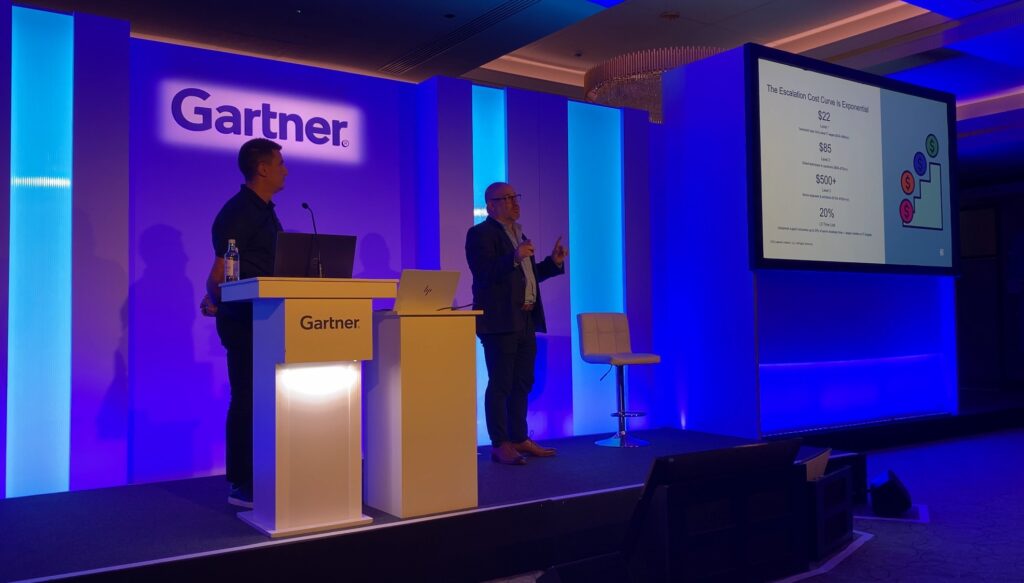
Lakeside Software presented new analysis on the operational cost of failed self-service, escalation, and diagnostic inefficiency during a session titled The Hidden Economics of DEX at the Gartner Digital Workplace Summit (DWS) in London.
The presentation explored how failed self-service journeys, repeated diagnostic verification, and fragmented support tooling contribute to hidden operational costs inside enterprise IT support environments.
According to the analysis presented by Lakeside Software AI Product Leader Oli Giordimaina, “failure demand” refers to support activity created by system issues, unsuccessful self-service journeys, and incorrect ticket routing rather than planned business activity.
The presentation highlighted that in some enterprise environments, 13% of incidents can account for as much as 80% of lost productivity, with failed self-service attempts increasing incident costs from roughly $6 to $53 once escalation and additional support involvement are factored in.
The analysis also explored the operational burden placed on Level 1 support teams, where analysts can spend as much as 60–70% of their time gathering information, verifying entitlements, and rebuilding context before meaningful troubleshooting begins.
A further issue discussed during the session was the growing “verification tax” inside enterprise IT operations, where escalated tickets trigger repeated diagnostic work because higher support tiers do not fully trust the troubleshooting already completed upstream.
According to the presentation, this verification process can effectively double the diagnostic cost of escalated incidents.
The session also examined the “swivel-chair integration tax” created by fragmented support tooling and disconnected operational systems. Instead of working from a shared operational view, support teams are often forced to move between multiple applications to manually piece together device, application, and user context.
Giordimaina noted that saving just one minute of context-switching time across 10,000 monthly tickets equates to 166 hours of recovered support capacity.
The presentation argued that traditional support metrics such as ticket volume and cost-per-seat do not fully capture the operational effort involved in diagnostic investigation, repeated troubleshooting, failed self-service, and ticket escalation.
The session also explored what Giordimaina described as the “human robot conundrum,” where rigid scripting and procedural troubleshooting can push support teams towards escalation before the root cause is fully understood.
The limitations of AI-driven support tools that rely heavily on historical ticket data and knowledge bases instead of live operational data were also flagged: “The system can sound intelligent while still being wrong,” said Giordimaina.
“If AI is working from previous tickets in place of live operational data, it is still inferring what might be happening instead of observing what is actually happening on the device.”
A major theme of the presentation was the need for operational models built around shared endpoint visibility and live telemetry rather than disconnected tools and repeated interrogation.
The session explored how organisations are increasingly applying Site Reliability Engineering (SRE) principles to end-user computing environments to reduce repeated diagnosis, improve first-contact resolution, and route incidents correctly the first time.
That includes giving support teams access to real-time endpoint telemetry, improving self-service taxonomy so users can describe issues naturally, and creating a shared endpoint system of record that removes the need for repeated verification between support tiers.
Giordimaina noted that organisations are becoming far more mature in how they approach AI-driven support operations.
Instead of pursuing automation for its own sake, many are focusing on measurable operational improvements such as routing accuracy, faster resolution, and reducing unnecessary escalation.
“Most enterprises do not have an automation problem,” said Giordimaina.
“They have a visibility and trust problem.”
Presentation link: https://www.lakesidesoftware.com/wp-content/uploads/2026/05/LakesideSoftware_The-Hidden-Economics-of-DEX.pdf




