Half of developers are finding security flaws in AI-generated code after it ships, research shows
Organisations across the UK and Europe are deploying code faster than their security teams can validate it, according to new research that puts hard numbers on a challenge growing in tandem with AI adoption.
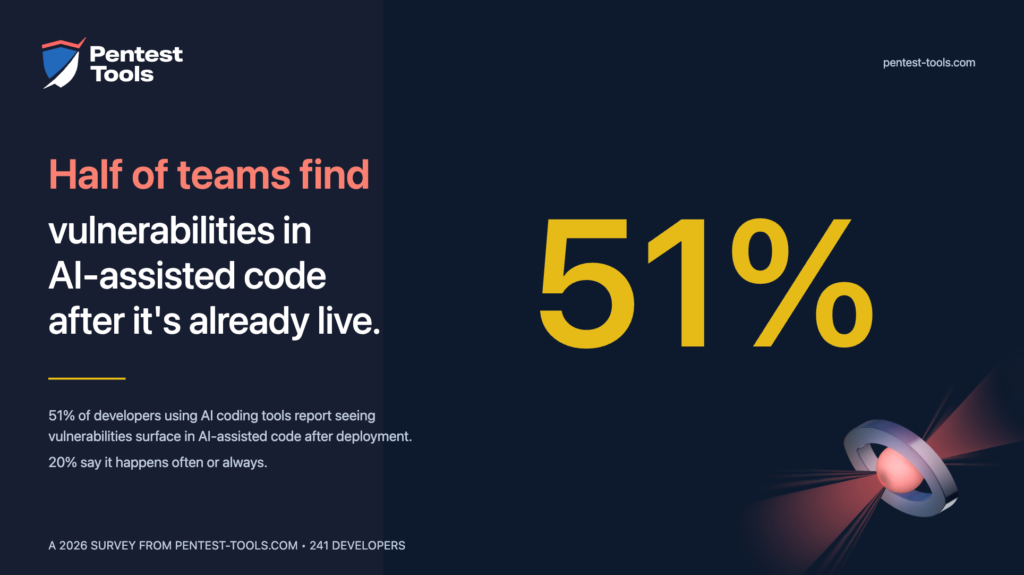
The study, commissioned by offensive security firm Pentest-Tools.com and conducted in March 2026 with 241 developers across the UK, Europe, and the US, found that 51% of practitioners discovered security vulnerabilities in AI-assisted code after it was already in production. Only 9% believe their vulnerability testing fully keeps pace with how quickly they are now shipping software.
AI tools are now standard, but security processes have not kept up
The pace of AI adoption in development teams has been rapid. Three in four developers (76%) say they use AI coding tools as a constant or near-constant part of their workflow, and 82% work at organisations that formally encourage or mandate the practice. The productivity gains are clear and widely reported.
What is less widely discussed is the security overhead those gains create. More code shipping faster means a larger attack surface, more integrations to assess, and more pull requests for security reviewers to work through. The research found that 30% of developers say they do not have enough time to thoroughly review AI-generated code before it is deployed. A further 34% acknowledged that the development pace has at least sometimes caused code to go live before security checks were complete.
A different kind of security risk
Developers surveyed described a notable shift in the type of issues emerging from AI-assisted work. Routine syntax errors and common implementation mistakes have become less frequent – AI tools handle these well. In their place, practitioners are seeing subtler problems: weak authentication patterns, insecure default configurations, and logic flaws that only become apparent when different parts of a system interact.
As one respondent put it: “AI hasn’t increased the number of vulnerabilities significantly, but it has made them more subtle and easier to overlook, which makes code review and validation even more important.”
These are precisely the issues that automated static analysis tools, which check code as written rather than as deployed, are least equipped to catch. They require a running system and, ideally, the kind of validation that tests whether a potential weakness is actually exploitable.
The compliance dimension
For businesses operating under UK and European regulatory requirements, including DORA, ISO 27001, and the NIS2 directive, the research raises a practical compliance question. Audit frameworks generally require organisations to demonstrate not just that code was reviewed, but that detected vulnerabilities were confirmed and remediated with a traceable evidence trail.
When development speed outpaces the validation process, that trail weakens. A pull request approved under time pressure, or a scan that ran after deployment, does not produce the kind of before-and-after artefacts that satisfy an auditor.
Teams finding a way through
The picture is not uniformly bleak. Around a third of respondents reported stable or improving security conditions, and the research identified common characteristics of those teams: structured workflows that treat AI suggestions with the same scrutiny as third-party code, security checks embedded at the point of code merge rather than bolted on after deployment, and in some cases using AI tools to conduct an automated first-pass review of AI-generated code before it reaches a human reviewer.
The Pentest-Tools.com report concludes that the validation gap is an operational challenge rather than an AI-specific one, but that AI has accelerated the conditions that create it and made the consequences harder to ignore.
The full report, ‘The Shrinking Validation Window’, is available here: https://pentest-tools.com/insights




