10 Best Enterprise HCM for UK Organisations: 2026 Guide

TL;DR
UK enterprise HCM buyers face a crowded market where legacy giants charge six-figure implementation fees and newer platforms promise agility they can’t always deliver at scale. This guide evaluates ten enterprise HCM platforms through a UK lens, scoring them on HMRC payroll compliance, pension auto-enrolment support, multi-country coverage, talent depth, and total cost of ownership. Bob from HiBob leads the list for UK organisations that want enterprise-grade capabilities without a multi-year deployment.
How this list was built
Each platform earned its position through a weighted assessment across five dimensions with UK requirements front of mind: UK payroll compliance and global workforce coverage (HMRC filing, pension auto-enrolment, and localisation reach), talent management maturity (performance, succession, and engagement features), implementation speed and total cost of ownership, user satisfaction signals from verified G2 and Capterra reviews, and platform architecture (API depth and AI capabilities). Platforms that scored well in one dimension but failed in others dropped in the rankings. Analyst reports from Gartner and Darwinbox’s market assessments informed the evaluation context.
What separates enterprise HCM from standard HR software
Standard HR software stores employee records and tracks time off. Enterprise HCM does those things, too, but extends into workforce planning, compensation modelling, and multi-entity payroll across jurisdictions alongside analytics that connect people data to business outcomes.
The distinction matters especially for UK organisations with international operations. A company with 150 employees in London and 80 in Berlin needs a platform that handles UK HMRC real-time information filing, pension auto-enrolment, IR35 off-payroll working rules, and German Betriebsrat requirements without duct-taping together separate regional tools. Enterprise HCM consolidates these workflows into a unified data layer, so one headcount change ripples through payroll, benefits, and financial planning without manual re-entry.
Three signals indicate that a UK organisation has outgrown standard HR software: finance teams can’t pull workforce cost data without asking HR to export spreadsheets, HMRC submissions require manual workarounds outside the core system, and new-country expansions stall because the existing platform lacks local compliance support.
Enterprise HCM comparison at a glance
| Platform | Best for | Global coverage | Implementation time
|
|---|---|---|---|
| HiBob (Bob) | Mid-sized and scaling global organisations | Native UK and US payroll, global hub | Weeks |
| SAP SuccessFactors | SAP-invested enterprises 1,000+ employees | 200+ countries | 12-24 months |
| Workday | Fortune 500 with complex global structures | 200+ countries | 12-18 months |
| UKG Pro | Shift-heavy industries needing scheduling depth | US-centric with global modules | 6-12 months |
| ADP Workforce Now | Payroll-first mid-market organisations | Strong US, expanding global | 3-6 months |
| Personio | European SMBs with DACH focus | EU-centric | 4-8 weeks |
| Rippling | Cross-functional HR, IT, and finance buyers | US-primary, expanding global | 4-8 weeks |
| Paycor | US mid-market with recruiting focus | US only | 6-12 weeks |
| Paylocity | US mid-market valuing social engagement features | US only | 8-12 weeks |
| Deel | Distributed teams hiring contractors worldwide | 150+ countries via EOR | Days to weeks |
1. HiBob (Bob)
 Enterprise-grade HCM that deploys in weeks, not fiscal years
Why it’s on this list
Bob deploys in weeks and still delivers the workforce planning, compensation management, and multi-country payroll capabilities that enterprise buyers require. G2 reviewers back that up with a 4.5/5 rating from over 1,811 verified reviews, with Capterra at 4.6/5 from 167+ reviews. Josh Bersin has called it “the Instagram of HCM platforms,” and the description captures something procurement teams care about: adoption rates that justify the investment without a 12-month change management programme.
Key capabilities
Unified architecture: One employee record feeds core HR, payroll, talent management, compensation, workforce planning, and engagement. Configuration happens through in-app settings, not consultant workshops.
Global payroll: Native UK payroll handles HMRC filing, IR35 classification, and pension auto-enrolment. Native US payroll covers federal and state processing. The Payroll Hub connects additional countries through no-code integrations.
Talent management: 360-degree performance reviews, 9-box calibration grids, succession planning, and compensation management with Mercer benchmarking data.
AI across workflows: CV summaries accelerate hiring, review summaries cut manager admin time, and sentiment analysis surfaces trends in engagement data.
Pricing: Not published. Modular pricing based on suite selection (Core, Talent, Payroll, Planning) and headcount.
Where it falls short: No public pricing adds friction during RFP benchmarking. Organisations above 2,000 employees with complex matrix hierarchies may find that Workday or SAP SuccessFactors offer deeper configurability for multi-level approval structures. Native payroll covers only the UK and US.
2. SAP SuccessFactors
 The enterprise HCM standard for organisations with deep SAP ecosystems
Why it’s on this list
SAP SuccessFactors covers more than 200 countries and plugs into SAP’s ERP stack, making it a default choice for organisations that run SAP for finance and procurement. Employee Central acts as the system of record, and data synchronises across SAP modules.
Key capabilities
Core HR and payroll: Employee Central stores global employee data with country-specific fields, and SAP maintains localised payroll engines for dozens of jurisdictions.
Talent management: Modules cover recruiting and onboarding alongside performance management and succession. The learning management system supports compliance training at scale.
Analytics: SAP Analytics Cloud connects HCM data to financial and operational metrics for cross-functional reporting.
Pricing: Enterprise licensing with implementation costs that reach into six or seven figures depending on scope. No published rates.
Where it falls short: G2 reviewers (4.1/5, about 1,500 reviews) describe the interface as complex with an outdated look. Implementation demands SAP-certified consultants, and timelines stretch past initial projections. The platform overwhelms organisations under 1,000 employees with configuration options they don’t need. SAP releases updates on a cycle that feels slow compared to cloud-native competitors.
3. Workday
 The analytics powerhouse for Fortune 500 global HR and finance operations
Why it’s on this list
Workday occupies a prominent spot in Gartner’s Magic Quadrant and serves some of the largest employers on the planet. The platform’s single-codebase model means every customer runs identical software, and the architecture connects HR and finance on one data layer.
Key capabilities
Financial and people planning: Workday Adaptive Planning lets finance and HR teams model headcount scenarios against revenue projections.
Global compliance: Operations span 200+ countries with multi-currency payroll support and country-specific regulatory modules.
Advanced analytics: Workday Prism Analytics combines people and finance data for custom dashboards. Machine learning surfaces attrition risk and skills gaps.
Pricing: Annual per-employee costs range from $50 to $200+ based on modules. Implementation fees add a substantial upfront investment.
Where it falls short: G2 reviewers (4.1/5 from 1,613 reviews) highlight an unintuitive interface that requires Workday-specific training. Deployments run 12 to 18 months with dedicated project teams. The investment and operational overhead make Workday a poor fit for companies below 500 headcount. Multiple reviews describe navigation as convoluted, with common tasks buried under layers of menus.
4. UKG Pro
 The workforce management specialist for shift-heavy, labour-intensive industries
Why it’s on this list
UKG Pro (once known as UltiPro) combines HCM capabilities with deep workforce management tools. Industries like healthcare and retail rely on UKG’s scheduling engine to handle complex shift patterns and labour law compliance.
Key capabilities
Scheduling and time management: The workforce management suite handles shift templates and overtime rules alongside labour cost forecasting across multiple sites.
Payroll and compliance: UKG processes payroll with strong US coverage and growing international capabilities.
Talent and culture: The platform includes recruiting and onboarding alongside performance management and employee sentiment tools through UKG Talk.
Pricing: Custom enterprise pricing based on modules and headcount. No published rates.
Where it falls short: G2 reviewers (4.3/5 from 2,187 reviews) note that the user interface varies in quality across modules. Some sections feel modern; others feel like legacy software that hasn’t received recent attention. Customer support quality fluctuates, with multiple reviews describing slow ticket resolution. Platform updates sometimes break existing configurations, and initial deployment requires significant internal project management resources.
5. ADP Workforce Now
 The established payroll processor expanding into HCM territory
Why it’s on this list
ADP processes payroll for millions of workers and brings decades of compliance expertise to its HCM suite. Workforce Now bundles HR administration and benefits management with payroll into a mid-market package backed by ADP’s regulatory monitoring infrastructure.
Key capabilities
Payroll processing: ADP’s core strength. The platform handles federal, state, and local tax filing with automated compliance updates.
Benefits administration: Carrier connectivity and open enrolment management with ACA compliance tracking.
Talent management: Performance reviews and goal tracking alongside compensation management.
Pricing: Per-employee pricing that varies by module selection. ADP requires a sales conversation for quotes.
Where it falls short: G2 reviewers (4.2/5 from 4,209 reviews) cite customer support as a chronic pain point, with 111 mentions of slow response times and unhelpful interactions. Interface navigation receives 98 negative mentions for outdated design and confusing menu structures. Reviewers flag restricted report customisation options (71 mentions), and the platform’s rigidity makes non-standard workflows difficult to implement. UK payroll capabilities lag behind ADP’s US offerings.
6. Personio
 The European HR platform purpose-built for SMBs expanding across EU markets
Why it’s on this list
Personio targets small and mid-sized European organisations with an HR platform that handles recruiting and onboarding with absence management alongside payroll preparation. The platform’s EU regulatory compliance and German-language support make it a familiar choice for DACH-headquartered companies.
Key capabilities
Recruiting: Multi-channel job posting and applicant tracking with collaborative hiring features.
Core HR: Employee records and digital personnel files with absence tracking.
Payroll preparation: Data export to external payroll providers with automated validation.
Pricing: Tiered plans (Core, Core Pro, custom) based on headcount and modules. Published starting prices with quotes for larger deployments.
Where it falls short: Native UK payroll processing isn’t available; UK teams need a separate payroll provider. G2 reviewers (4.4/5 from 838 reviews) identify the performance review module as basic, without calibration tools or succession planning. Time tracking receives negative feedback for inflexibility. Pricing has increased at renewal, surprising some customers.
7. Rippling
The unified HR, IT, and finance platform for cross-functional automation
 Why it’s on this list
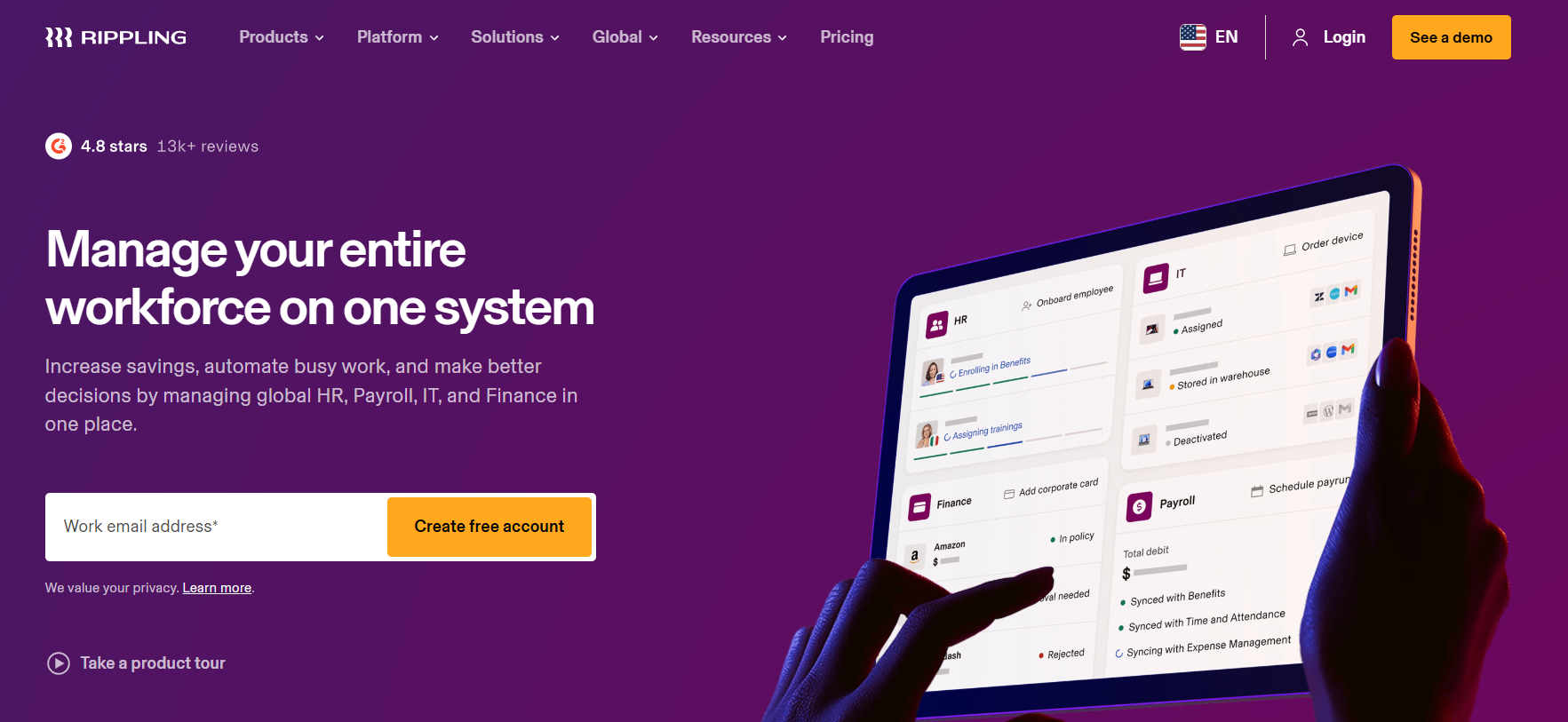
Rippling’s employee graph architecture connects identity and payroll data to device records in one system. The platform automates cross-functional workflows: onboarding a new hire can trigger laptop shipping and SaaS provisioning alongside benefits enrolment from a single event.
Key capabilities
HR Cloud: Payroll processing (US-centric), benefits administration, and time tracking with compliance monitoring.
IT Cloud: Device lifecycle management and app provisioning with security policy enforcement.
Finance Cloud: Corporate cards and expense management.
Pricing: Base platform starts at $8 per user per month. Each product cloud adds incremental costs, and total spend rises as organisations stack HR, IT, and finance modules.
Where it falls short: G2 reviewers (4.8/5 from 12,635 reviews) give Rippling high overall scores, yet negative reviews cluster around US-centric defaults that create friction for international teams. The initial configuration period demands technical investment. Mobile app functionality trails the desktop experience. Costs compound as buyers add product clouds beyond the base.
8. Paycor
 The US payroll and recruiting platform for mid-market HR teams
Why it’s on this list
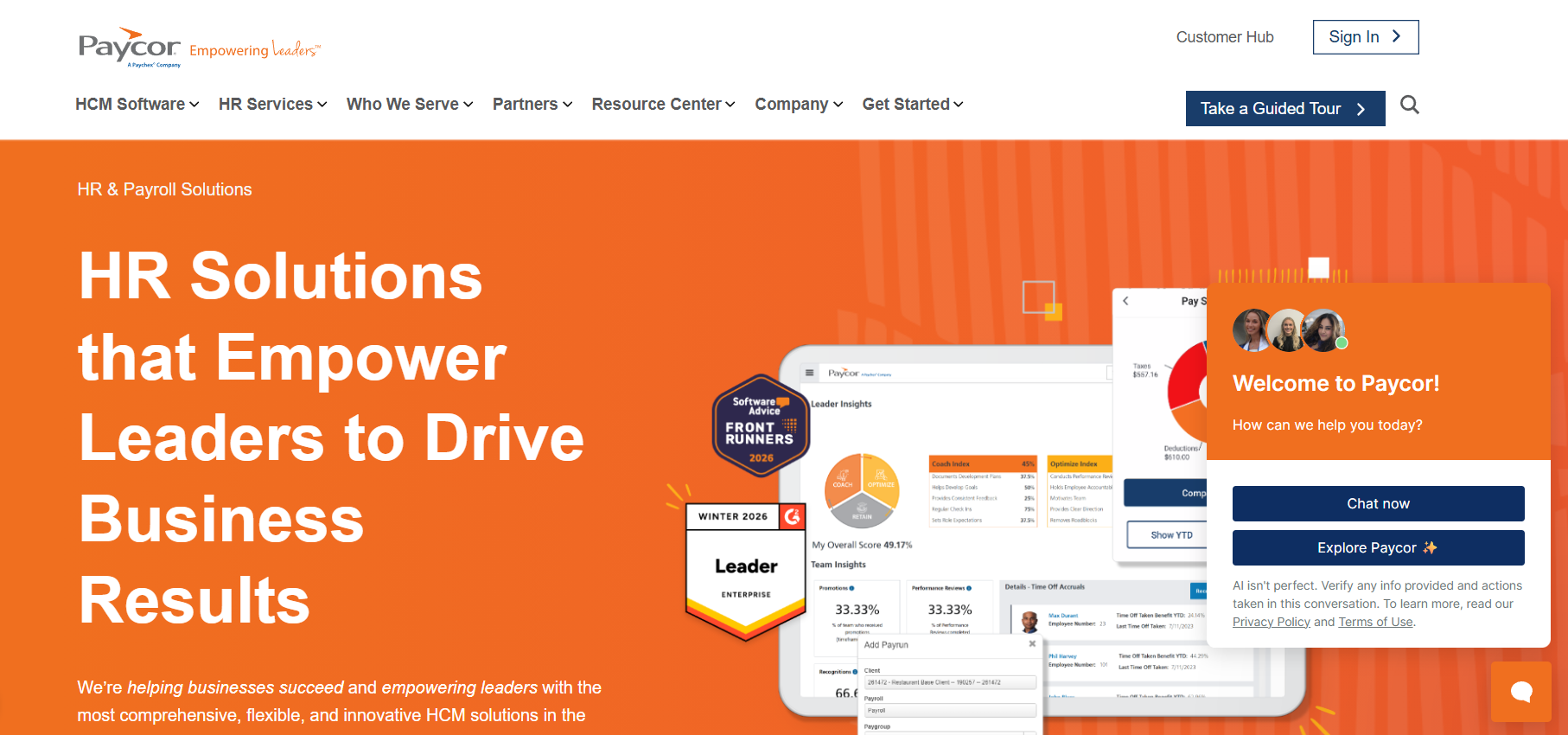
Paycor combines payroll processing with recruiting and workforce management tools. The platform targets US mid-market companies and emphasises its recruiting workflow, from job posting through offer letter.
Key capabilities
Payroll and tax: US payroll with automated tax filing and wage garnishment processing.
Recruiting: Career site management and applicant tracking with interview scheduling.
Workforce management: Time tracking and scheduling with labour cost analytics.
Pricing: Paycor offers tiered plans with per-employee pricing. Mid-market and enterprise buyers need to request a quote.
Where it falls short: G2 reviewers (3.9/5 from 1,333 reviews) identify customer support as the dominant complaint, with users reporting long wait times and unresolved tickets. Payroll processing errors surface in multiple reviews. The interface feels inconsistent across modules, and the platform lacks global coverage for organisations with non-US employees.
9. Paylocity
 The US mid-market platform emphasising community and social engagement features
Why it’s on this list
Paylocity targets US mid-sized companies and differentiates through social engagement tools, including a Community feature that functions as an internal communication hub. The platform covers payroll, HR, and benefits alongside talent and workforce management.
Key capabilities
Community and engagement: Internal social feed and peer recognition tools designed to increase employee interaction.
Payroll: US payroll with tax filing and on-demand payment options.
Talent acquisition and management: Recruiting workflows and onboarding paired with performance reviews.
Pricing: Per-employee pricing based on selected modules. Buyers need to request a quote.
Where it falls short: G2 reviewers (4.4/5 from 5,311 reviews) report that support quality declines during peak periods like year-end and open enrolment. The platform serves US companies alone, with no global payroll or multi-country compliance. Several reviews flag steep learning curves for administrators, and the platform offers fewer report customisation options than analytics-focused competitors.
10. Deel
The global contractor and EOR specialist adding HRIS capabilities
Why it’s on this list
Deel built its reputation on employer-of-record (EOR) services and contractor payments across 150+ countries. The platform has since expanded into HRIS territory, offering core HR features alongside its global hiring infrastructure.
Key capabilities
EOR and contractor management: Deel handles local employment contracts and tax compliance for contractors and EOR employees across 150+ countries.
Global payroll: Consolidated payroll across multiple countries through Deel’s network of local entities and partners.
HRIS: Employee records and org charts with time off tracking. The HRIS layer is newer and still maturing.
Pricing: EOR services charge per-employee fees that vary by country. Contractor management starts at $29 per contractor per month. HRIS features are available on select plans.
Where it falls short: G2 reviewers (4.7/5 from 6,596 reviews) note high withdrawal fees for contractors in certain regions. The HRIS module lacks the depth of dedicated HCM platforms; features like performance management and succession planning are absent or minimal. Support quality varies by region according to multiple reviews. Full-time employee costs through the EOR model can exceed what organisations pay through local entities with a dedicated HCM platform.
Selecting the right enterprise HCM for your UK organisation in 2026
The platform that fits depends on organisational scale, UK compliance requirements, and which workflows drive the most pain today. SAP SuccessFactors and Workday serve enterprises with 1,000+ employees and the budget for year-long implementations. UKG Pro suits shift-heavy industries that need scheduling precision. Deel fills a gap for distributed teams hiring contractors without local entities. Paycor and Paylocity serve US mid-market companies and lack native UK payroll.
For UK organisations that need enterprise-grade talent management, native HMRC payroll with pension auto-enrolment and IR35 compliance, AI-embedded workflows, and a platform that deploys in weeks, Bob from HiBob occupies a position that the legacy vendors and the lightweight tools both miss. It matches the feature depth of the enterprise tier while preserving the speed and usability that mid-sized, growing UK organisations require.
Enterprise HCM questions answered
What distinguishes enterprise HCM from mid-market HR software?
Enterprise HCM platforms handle multi-entity structures and multi-country payroll alongside advanced workforce planning with ERP integration. Mid-market tools cover core HR and basic talent features. Bob from HiBob bridges this gap with enterprise capabilities in a platform that mid-sized organisations can deploy without a consulting team.
How long does an enterprise HCM implementation take?
Timelines vary from weeks to over a year. Legacy platforms like Workday and SAP SuccessFactors require 12 to 24 months with dedicated implementation partners. Cloud-native platforms like Bob complete deployments in weeks, with phased module rollouts extending over subsequent months.
Where does HiBob sit in Gartner’s HCM analysis?
Gartner’s Magic Quadrant focuses on suites serving 1,000+ employee enterprises, where Workday and SAP hold prominent positions. Darwinbox’s enterprise assessment lists HiBob as a reliable HCM provider. Bob’s strength sits in the mid-market and scaling-enterprise segment, where Gartner’s coverage is thinner.
What’s the total cost of ownership for an enterprise HCM platform?
TCO includes licensing fees and implementation services alongside ongoing admin training and the productivity cost of system changes. Legacy enterprise platforms often carry TCO figures two to five times their annual license cost. Platforms like Bob reduce TCO through faster deployment and modular pricing that avoids paying for unused features.
How do enterprise HCM platforms handle API integrations?
Most enterprise platforms offer REST APIs and pre-built connectors for popular tools. Bob provides open APIs and SSO support alongside a marketplace of integrations with platforms like Slack and Microsoft Outlook. The depth of API documentation and connector availability varies across vendors, so evaluating integration support for your existing tech stack should happen during the proof-of-concept phase.
Can a mid-sized company benefit from enterprise HCM features?
A 300-person company with offices in three countries faces many of the same challenges as a 3,000-person enterprise: multi-country compliance and workforce planning with skills-based talent management. Bob delivers these enterprise features to mid-sized organisations without the implementation overhead that makes legacy platforms impractical below 500 employees.
What payroll compliance features should UK organisations prioritise?
UK-specific requirements include HMRC real-time information filing, IR35 off-payroll working rules, and P60 end-of-year summaries alongside pension auto-enrolment. Bob handles all of these through its native UK payroll module. Platforms without native UK payroll require third-party providers, adding cost and integration complexity.




