AI could unlock up to $90bn in marketing returns in the US alone, yet an “AI marketing cognitive dissonance” is standing in the way
AI could unlock up to $90bn in improved marketing returns in the US alone, according to McKinsey & Company’s research, ‘From campaigns to continuous growth: AI capabilities shaping marketing’. Yet fewer than 10 percent of organizations have successfully scaled AI across marketing or captured AI’s true value across marketing workflows.
McKinsey estimates that when organizations redesign marketing to be powered by AI, where insight, creation, personalization, and optimization operate in real time they see: two-to-three-times productivity gains, 10 to 30 percent in savings, and four to seven percent growth in revenue and conversion value.
In collaboration with Google, McKinsey explores why AI marketing transformations were “slow-rolling”. The research – ‘From Anxiety to Advantage: A Marketing Organization that Thrives with AI’ – interviewed 500 global marketers and uncovered an ‘AI marketing cognitive dissonance’ – while 86 percent of marketers are excited about AI’s potential, 57 percent are anxious about its implications. And, for CMOs that dissonance was more extreme: 96 percent are excited about AI, yet 71 percent express anxiety and 80 percent believe AI could put their own role at risk.
The research identified two issues slowing down AI transformations:
Superficial AI execution is prevalent. Despite 60% of marketers using AI multiple times per week, only 28 percent of marketers say their companies as pursuing a fundamental rewiring of their marketing teams and workflows.
CFO-CMO AI growth-disconnect. More than half of marketers (53%) value AI more as a driver of growth than as a driver of efficiency. However, marketers believe the C-suite value AI for productivity, a concern amplified by the fact that the C-suite, and the CFO in particular, tend to view marketing as a cost center.
The ‘From campaigns to continuous growth: AI capabilities shaping marketing’ research identifies five AI capabilities shaping the future of marketing, to drive both growth and productivity.
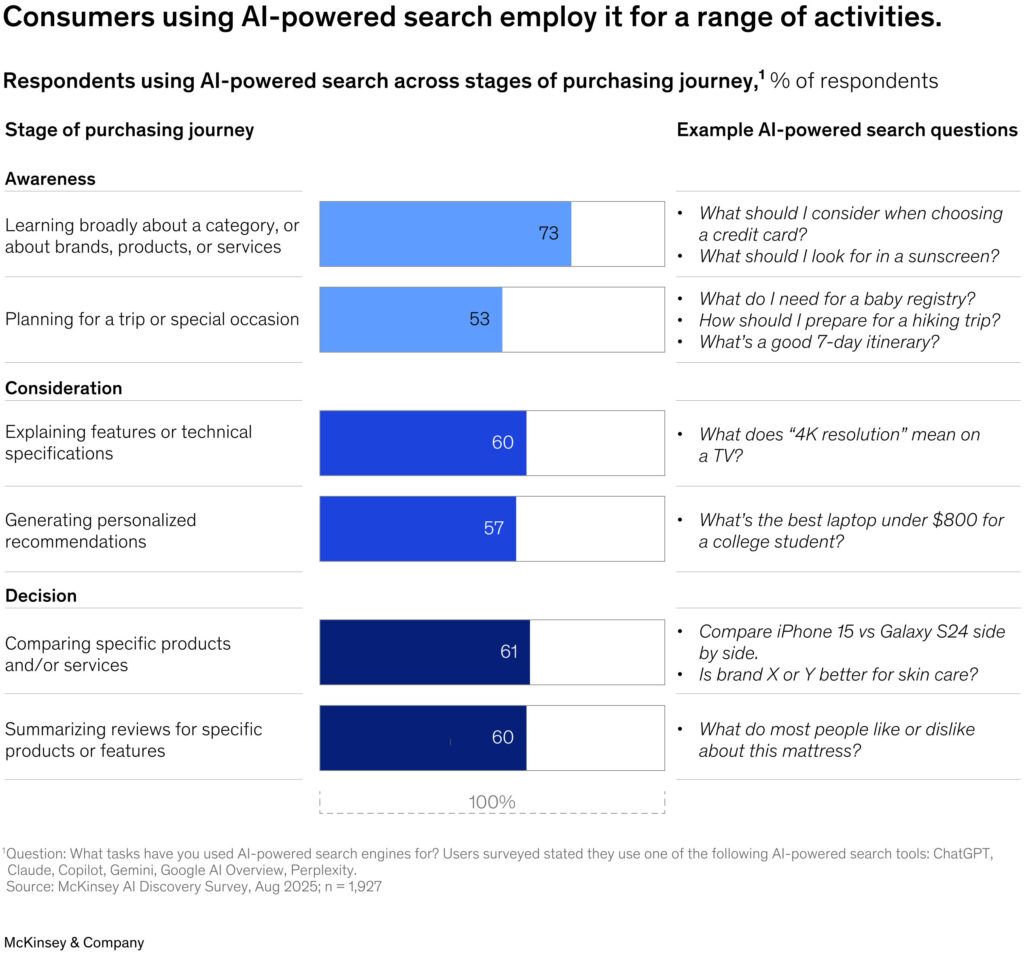
AI whisperers that drive sales in agentic commerce: As agentic commerce plays a greater role in product discovery, evaluation and purchase decisions, a new key role has emerged – the Agent Whisperer. They will ensure brands are accurately represented in AI systems to ensure they can influence the $750B of consumer spend that will flow through AI-powered search by 2028.
Hyper-personalization architects that deliver one-to-one experiences: Marketers will shift from segment-based marketing to delivering one-to-one customer experiences delivered in real time. This AI-driven personalization can increase revenue by 5 to 8 percent, improve customer satisfaction by 15 to 20 percent, and reduce cost-to-serve by up to 30 percent.
Full-funnel navigators that orchestrate always-on marketing: Campaign cycles will fade away and be replaced by always-on orchestration. When properly configured marketing ROI will improve by up to 30 percent. And, the time marketers spend on execution tasks will reduce from 60–70 percent to as little as 10–15 percent. This frees up teams to focus higher-value activities.
Creative gurus that compress campaign cycles from 6-10 weeks to same day execution: Organizations will move to scaled creativity where large volumes of tailored content will be delivered while maintaining a consistent brand. In some cases, this is already returning two- to five-fold increases in creative productivity and 10 to 30 percent reductions in creative costs.
Customer wayfinders that test and learn with always-on customer insights: Marketers will design workflows that give them the ability to translate signals from customers, markets, and channels directly into decisions in real time. One example of this is the creation of digital twin that simulates consumer personas, so they can be used to test responses to campaigns, pricing, and products.
Kelsey Robinson, Senior Partner at McKinsey & Company: “AI adoption is happening faster than value creation. Nearly sixty percent of marketers are using AI multiple times per week, yet fewer than ten percent of organizations have successfully captured value across marketing workflows. This AI adoption-value disconnect could have profound consequences on the organizations that don’t catch-up.”
Julien Boudet, Senior Partner, McKinsey & Company: “Marketing leaders are caught between optimism and anxiety. They see AI’s enormous potential, yet worry about its impact on talent, creativity, and competitive advantage. That tension is understandable. But, standing still is the riskiest strategy of all. The organizations moving fastest to redesign how marketing works around AI are already achieving two-to-three times productivity gains, four to seven percent revenue growth, and up to thirty percent higher marketing ROI.”
Marie Gulin-Merle, Global Vice President, Ads and Commerce Marketing at Google:
“The lines between performance and brand marketers will continue to blur in the next era of AI, requiring us to think more holistically across the entire customer journey. This is giving rise to ‘orchestrators’—marketers who can connect teams and AI-enabled workflows to drive real business results.”
About the research
From campaigns to continuous growth: AI capabilities shaping marketing
Authors: Eli Stein, Jamie Wilkie, Julien Boudet, Kelsey Robinson, Lalit Bhagia with Emily Scofield
From Anxiety to Advantage: A Marketing Organization That Thrives With AI
Authors: Jacob Ader Kelsey Robinson and Jim Lecinski, with Heather Gouinlock
The McKinsey Global Marketer Survey was fielded in March 2026. McKinsey collected 521 responses from global marketers and advertisers, including, C-level roles, vice presidents, directors, managers and individual contributors in-house at companies with self-reported annual marketing spend from $5 million to >$5 billion.




