AI Data Centre Boom Fuels New Demand for Ultra-Precise Laser Technology
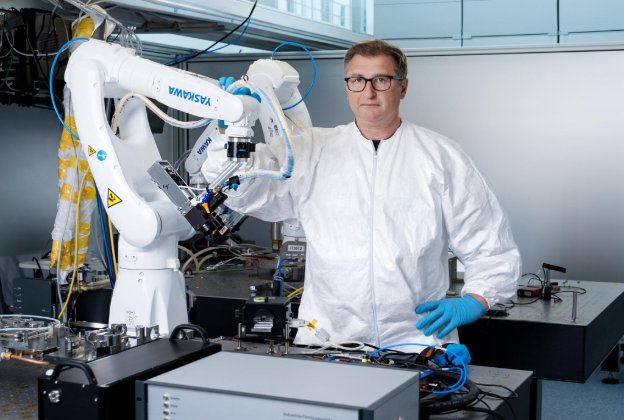
Nikolajus Gavrilinas, co-founder and CEO of LITILIT. (Source: LITILIT)
The extraordinary investment pouring into artificial intelligence infrastructure is creating opportunities far beyond chips, servers and data centre construction, with advanced laser technology emerging as another potential beneficiary of the AI boom.
As technology companies race to build increasingly powerful data centres, manufacturers face the challenge of producing highly sophisticated components capable of moving enormous quantities of data quickly and efficiently. Among the technologies helping to make those components possible are femtosecond lasers – ultra-precise systems capable of processing delicate materials while generating very little heat.
The lasers emit extremely short pulses lasting just quadrillionths of a second, allowing manufacturers to cut, drill and modify next-generation materials without causing the cracking, chipping or thermal damage that can occur with conventional manufacturing techniques.
The technology is already being used in the production of components for advanced optical connections and other equipment destined for AI infrastructure.
AI Infrastructure Spending Set To Soar
The potential market is significant.
A Goldman Sachs report estimates that annual AI infrastructure capital expenditure could rise from $765 billion in 2026 to around $1.6 trillion by 2031, as companies invest heavily in computing capacity, new data centres and the energy infrastructure required to support them.
However, expanding AI capacity is not simply a question of spending more money. The report also highlights potential constraints involving power availability, labour and equipment, which could increase the time between companies committing capital and new data centres becoming operational.
Nikolajus Gavrilinas, CEO and co-founder of Lithuanian femtosecond laser manufacturer LITILIT, believes precision manufacturing equipment could represent another, less obvious, part of the infrastructure challenge.
“Many advanced AI components, from semiconductor packages, glass substrates, to optical interconnects and advanced PCBs, require manufacturing technologies that can process materials without introducing heat damage. Femtosecond lasers are becoming one of the key enabling tools for this transition, and we believe demand will grow rapidly as AI manufacturing scales,” Gavrilinas says.
Faster Data Transfer Becomes Critical
One of the biggest challenges facing the data centre industry is moving information between increasingly powerful processors quickly enough.
As AI models become larger and computing clusters expand, the connections between chips, servers and other equipment become increasingly important to overall performance.
TrendForce has forecast rapid growth for co-packaged and near-packaged optics – technologies designed to use optical connections to increase data-transfer speeds. According to figures cited by LITILIT, the market could grow from approximately $100 million in 2025 to more than $39 billion by 2030.
That would represent a dramatic expansion of the supporting technologies required to manufacture advanced optical and semiconductor components.
Femtosecond lasers can, for example, be used in the production of glass interposers. These sophisticated wiring layers can help connect chiplets used within advanced AI hardware.
The laser drills microscopic holes through glass before those openings are filled with copper, creating tiny vertical electrical connections.
“A normal laser or mechanical drill heats the material as it cuts, and glass can crack or chip when heated unevenly. A femtosecond laser fires pulses so short – quadrillionths of a second – that the surrounding glass has almost no time to heat up. The same precision is also used to manufacture other data center equipment wherever something needs to be cut, trimmed, or fixed with almost no heat,” Gavrilinas explains.
Scaling Laser Production Presents Its Own Challenge
Despite the potential increase in demand, manufacturing femtosecond lasers at industrial scale presents challenges of its own.
Many existing systems evolved from lasers originally developed for scientific applications. While capable of delivering extremely high levels of performance, such equipment can be complicated to manufacture, automate and integrate into large-scale industrial production lines.
Specialist expertise can also be required to operate and maintain the systems.
LITILIT is attempting to address that barrier through technology developed by co-founders Kęstutis Regelskis, Nerijus Rusteika and Nikolajus Gavrilinas in collaboration with the Center for Physical Sciences and Technology (FTMC) in Vilnius.
The company says its patented approach (patent1, patent 2) has been designed specifically for industrial manufacturing, reducing component complexity while enabling greater levels of automation.
In June 2026, LITILIT began construction of a new laser manufacturing facility in Vilnius. The company ultimately plans to reproduce the manufacturing model in other markets through partnerships with international organisations.
AI Boom Creates Opportunities Across The Supply Chain
The development highlights how the economic impact of artificial intelligence infrastructure is spreading through an increasingly broad industrial supply chain.
Attention surrounding AI investment has largely concentrated on semiconductor manufacturers, hyperscale data centre operators and energy providers. However, producing the next generation of computing infrastructure also requires highly specialised manufacturing technologies capable of working with increasingly complex materials and components.
If forecasts for AI infrastructure and optical connectivity prove accurate, the companies supplying those manufacturing tools could become an increasingly important – if less visible – part of the global AI investment story.
For LITILIT, the bet is that femtosecond lasers will move beyond their specialist scientific origins and become a mainstream industrial manufacturing technology as the requirements of AI hardware continue to increase.
About LITILIT
LITILIT is a femtosecond laser startup headquartered in Vilnius, Lithuania. The company manufactures lasers based on patented technology that enables scalable production and makes them easier to integrate into industrial systems. By bringing femtosecond lasers to the cost and integration simplicity of fiber nanosecond lasers, LITILIT aims to accelerate their adoption as the next standard for industrial manufacturing. The company is developing a large-scale production facility in Vilnius and plans to replicate this model in other regions together with international partners. Learn more at https://www.litilit.com/




