VR.cam03 Targets Spatial Computing and Edge AI With High-Bandwidth 8K Video
Mark Baker, UK Tech News Editor September 2, 2026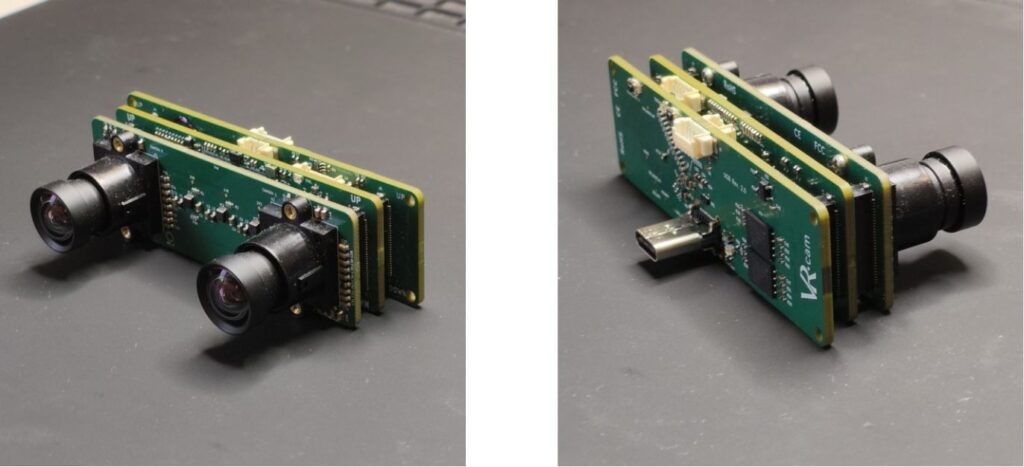
Marseille-based imaging technology company VR.cam has confirmed that its forthcoming VR.cam03 camera is ready for release, although pricing, availability and pre-order information have yet to be announced.
The camera is built around field-programmable gate array technology supplied by Efinix. FPGAs are reprogrammable processors that can be configured for specialised workloads, making them particularly suitable for applications requiring fast, efficient and low-latency data processing.
VR.cam says its new system will support side-by-side YUV 4:2:2 video at 4K resolution and 60 frames per second, or 8K at 30 frames per second. A USB-C 3.2 interface will carry up to 20Gbps of uncompressed visual data.
That level of bandwidth is intended to support workloads where latency and image quality are critical, including virtual and augmented reality, machine vision, three-dimensional environment capture and AI-assisted industrial systems.
Christian Caumont of VR.cam said:
“The breakthrough performance of the VR.cam03 simply wouldn’t be possible without the sheer performance and efficiency of Efinix FPGAs. Their world-class tools and software libraries have allowed us to overcome previous hardware limitations. We aren’t just launching a camera; we are launching an ecosystem capable of handling the future of spatial computing and edge AI.”
On-Device AI Planned for VR.cam03
While the initial specification concentrates on high-resolution, low-latency imaging, VR.cam has also outlined a wider software and hardware roadmap for the platform.
One of its principal development priorities is the ability to run machine-learning models directly on the camera. This approach, commonly known as edge AI, allows visual information to be analysed close to where it is captured instead of sending all the data to a remote server or host computer.
Local processing could reduce reliance on an attached CPU or graphics processor while improving response times in systems that must identify objects, movements or abnormalities almost instantly.
Potential uses could include automated manufacturing inspections, robotic navigation, security monitoring and immersive computing systems. Processing locally may also help reduce network traffic when only selected findings, rather than an entire video stream, need to be transmitted.
Event Detection at Up to 1,000fps
VR.cam is also planning a high-frequency event-detection mode capable of operating at up to 1,000 frames per second.
The proposed feature would focus on capturing extremely rapid events and anomalies that conventional video systems may miss. Possible applications include industrial fault analysis, laboratory research, sports performance monitoring and the observation of fast-moving machinery.
The company has not yet published detailed information about the resolution, field of view or recording duration that would be available at the maximum frame rate.
However, the feature demonstrates how VR.cam intends to position the device as a programmable vision platform rather than solely as a conventional high-resolution camera.
Depth Sensing and Real-Time Spatial Mapping
Time-of-flight depth sensing is another capability on the product roadmap. ToF systems calculate depth by measuring the time taken for emitted light to travel to an object and return to a sensor.
Adding this information to a standard image allows a system to understand the distance and position of objects within a scene. This can be useful for robotics, immersive reality, automated navigation, digital twins and other technologies that must interpret three-dimensional environments.
VR.cam plans to combine depth sensing with real-time point-cloud streaming. Point clouds are large collections of spatial data points used to create a digital representation of a physical object or environment.
Generating and transmitting this information in real time could allow connected systems to map changing environments without having to process all of the raw data on a separate computer.
Camera Could Support 4D Gaussian Splatting
The company has also identified 4D Gaussian Splatting as a future application for the VR.cam03.
Gaussian Splatting is an emerging graphics technique used to create photorealistic three-dimensional scenes from visual data. Adding a fourth, time-based dimension makes it possible to represent movement and changes within those scenes.
VR.cam says its system is intended to provide the high-volume visual data needed to build these dynamic models. Possible applications could include virtual production, immersive broadcasts, digital twins, remote collaboration and interactive training environments.
Delivering this capability will depend not only on the camera hardware but also on the software, capture configuration and processing infrastructure surrounding it.
Efinix Highlights Compact, Energy-Efficient Processing
The involvement of Efinix reflects the growing use of adaptable processors in smart cameras and edge-computing devices.
Unlike fixed-function hardware, an FPGA can be reconfigured to perform specific image-processing or AI tasks. This flexibility may allow manufacturers to add or improve capabilities through future development without replacing the central processing hardware.
Mark Oliver, vice-president of marketing and business development at Efinix, said:
“We are delighted to see VR.cam bringing the VR.cam03 to life. The VR.cam03 showcases exactly the types of applications where Efinix FPGAs excel. They deliver high-speed compute facilitating the deployment of complex edge AI algorithms, all within a compact and energy efficient hardware footprint.”
VR.cam has not yet confirmed a firm launch date or disclosed how much the camera will cost. The company said availability, pricing and pre-order details would be released in the coming weeks.
Further launch updates will be published through the VR.cam website




