Could Advanced Lasers Give Industrial Robots a New Generation of Skills?
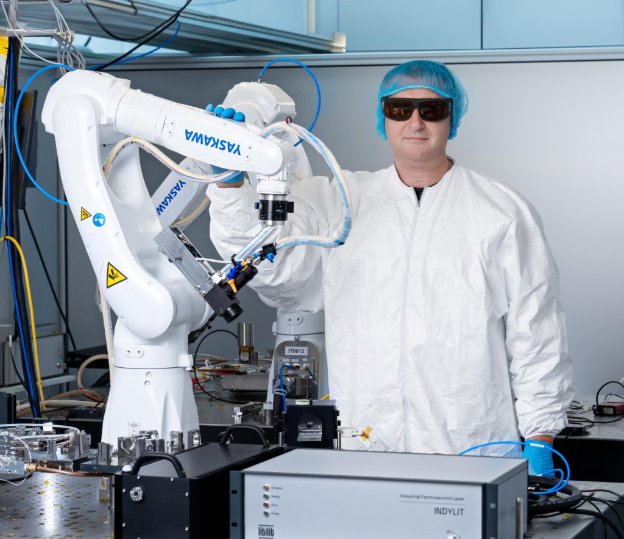
Nikolajus Gavrilinas, co-founder and CEO of LITILIT. (Source: LITILIT)
Industrial robots could soon graduate from gripping components and tightening screws to carrying out highly specialised manufacturing processes, as advances in compact laser technology create new possibilities for automation.
The rapid development of artificial intelligence has put robotics firmly back in the technology spotlight, but smarter software is only one part of the transformation taking place.
Improvements in robotic hardware are allowing industrial machines to become stronger, more accurate and increasingly capable of performing complex operations. Now, laser manufacturer LITILIT believes the next major step could involve equipping robotic arms with femtosecond lasers capable of carrying out extremely precise manufacturing processes.
Such systems could potentially be used in electronics, semiconductor production, electric vehicle manufacturing and medical technology, extending industrial robots far beyond the assembly and material-handling jobs for which they are best known.
Robotics Investment Accelerates
Money is already pouring into the robotics sector.
Investment in robotics reached $47.4 billion during the first six months of this year, according to Crunchbase calculations, representing an increase of 80% compared with the corresponding period last year.
Industry forecasts suggest the wider robotics market could expand dramatically over the next decade as businesses seek to automate more processes.
Humanoid robots are expected to contribute to that growth, particularly as manufacturers, logistics operators and other employers investigate technology capable of addressing labour shortages and undertaking repetitive, dangerous or physically demanding jobs.
A Barclays report estimates that the humanoid robotics market could grow from around $2 billion to $3 billion today to as much as $200 billion under its most optimistic scenario.
However, Nikolajus Gavrilinas, co-founder and CEO of Lithuanian laser manufacturer LITILIT, believes increasingly capable robots could also transform higher-value areas of manufacturing.
“Most industrial robots today are used with tools for gripping, screwdriving, bolting, drilling, packing, or similar tasks. Once you equip the same machine with an advanced laser, it can move into a different category of work: precision manufacturing. That means processing materials with much higher accuracy and creating more value from the same automated platform,” Gavrilinas says.
What Is a Femtosecond Laser?
Femtosecond lasers produce pulses lasting only a tiny fraction of a second – one femtosecond is one quadrillionth of a second.
The extremely short pulses allow manufacturers to process materials with very high precision while minimising heat transfer into the surrounding area.
That is particularly valuable when working with delicate electronics, glass and other materials where excessive heat could damage neighbouring structures.
Combining a femtosecond laser with an advanced robotic arm could therefore allow manufacturers to automate some highly specialised processes while retaining the flexibility associated with robotics.
According to Gavrilinas, potential applications include drilling through-glass vias used in semiconductor interposers, cutting curved cover glass for foldable smartphones and creating permanent traceability markings on electric vehicle batteries.
There could also be opportunities in medical-device manufacturing and other sectors where accuracy and control are critical.
Size Remains a Major Challenge
Turning the concept into an everyday industrial tool is not straightforward.
One of the biggest problems is the physical size and complexity of traditional femtosecond lasers.
Many ultrafast laser systems evolved from scientific equipment designed primarily for laboratories rather than robotic production lines. Consequently, systems can be large and require specialist maintenance.
LITILIT says it has deliberately designed its laser architecture to address those limitations, with its units around 1.5 to two times smaller than a typical femtosecond laser.
“Most femtosecond lasers historically came from scientific systems. They can deliver strong performance, but they are often large, complex, and require periodic maintenance. Our lasers use a modular design, high level of automation and reduced component complexity, making them compact enough for robotic integration and practical enough for industrial use,” Gavrilinas explains.
Making the equipment smaller could be particularly important for robotic applications because additional weight and bulk can restrict how quickly and accurately a robotic arm moves.
Implications for UK Advanced Manufacturing
For the UK, developments in this area could prove particularly relevant to industries where automation and high-value manufacturing increasingly overlap.
Semiconductors, aerospace, automotive manufacturing, photonics, electronics and medical technology all require processes capable of working to extremely fine tolerances.
Greater integration between robotics and advanced laser systems could potentially allow manufacturers to automate more of these complex operations rather than restricting robots primarily to assembly, welding and material handling.
It could also make production lines more flexible.
A robotic arm that can be fitted with different specialist tools potentially allows manufacturers to adapt production systems as products change, rather than relying entirely on dedicated machinery designed for one process.
However, attaching a laser to a robot does not automatically create a precision manufacturing system.
Positioning accuracy, vibration, laser safety, optical alignment, software integration and repeatability all become important considerations, particularly when components must be manufactured within extremely tight tolerances.
LITILIT Prepares to Scale Production
LITILIT is meanwhile preparing to increase production of its own femtosecond laser technology.
The company is developing a new factory in Vilnius, Lithuania, with production scheduled to begin in October.
It plans eventually to manufacture as many as 3,000 lasers annually, which LITILIT says would put the facility among the world’s highest-capacity femtosecond laser factories.
The company’s technology incorporates patented inventions developed by co-founders Kęstutis Regelskis, Nerijus Rusteika and Nikolajus Gavrilinas in close collaboration with the Center for Physical Sciences and Technology (FTMC) in Vilnius.
Whether laser-equipped robots become commonplace will ultimately depend on economics as much as engineering.
But as industrial robots become more precise and ultrafast lasers become smaller and easier to integrate, the range of processes suitable for automation could expand considerably.
Instead of simply replacing repetitive manual labour, the next generation of industrial robots could increasingly find itself carrying out some of the most technically demanding jobs on the factory floor.




