NordLayer Launches AI Scout to Help Businesses Monitor Shadow AI and Prevent Data Leaks
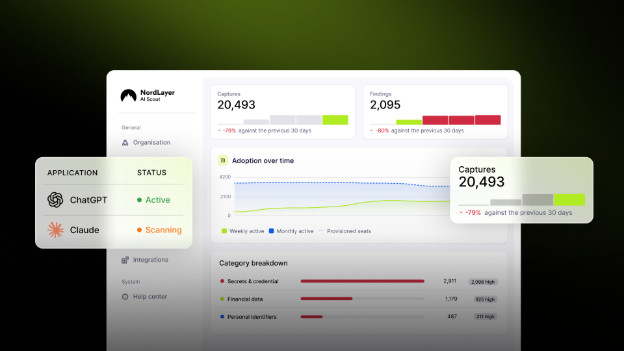
New cybersecurity platform provides visibility into workplace AI usage, employee prompts and AI agent connections, with built-in data loss prevention tools.
Cybersecurity company NordLayer has launched a new AI monitoring and security solution designed to help businesses identify unauthorised artificial intelligence tools, track employee AI adoption and reduce the risk of sensitive company information being exposed.
The new platform, NordLayer AI Scout, provides organisations with a centralised view of how artificial intelligence is being used across web browsers and desktop applications, including tools that have not been formally approved by IT departments.
The launch comes amid growing concerns about shadow AI, where employees use publicly available AI applications for work without the knowledge or approval of their employers.
As generative AI becomes increasingly embedded in everyday business operations, security teams face the challenge of monitoring a rapidly expanding range of tools, applications and autonomous AI agents.
NordLayer, part of Nord Security, the company behind NordVPN, says its new solution is intended to address this visibility gap while allowing businesses to benefit from AI adoption without unnecessarily restricting employee productivity.
Growing AI Adoption Creates New Security Challenges
Businesses are investing heavily in artificial intelligence, but the speed of adoption is creating additional cybersecurity risks.
According to Writer’s 2026 AI Adoption in the Enterprise survey, 59% of companies are investing more than $1 million annually in AI technology.
However, investment in approved corporate systems does not necessarily reflect how employees are using AI in practice.
Research from the University of Melbourne found that just 42% of employees use company-provided AI tools, while 70% reported using free, publicly available large language models (LLMs) at work.
This creates potential security vulnerabilities when employees enter confidential business information, customer records, proprietary code or commercially sensitive material into AI systems without appropriate safeguards.
IBM research has also highlighted the financial consequences of shadow AI, reporting that data breaches involving unauthorised AI tools incurred approximately $400,000 in additional costs compared with other breaches.
For organisations, the challenge is therefore not simply deciding which AI platforms to purchase, but understanding which applications employees are already using and what information they may be sharing.
Andrius Buinovskis, VP of Product Strategy at NordLayer, said:
“What companies are facing today is an AI zoo — dozens of unsanctioned LLMs in daily use across the workforce, each one widening the organization’s exposure to data leaks and security breaches.
“True AI governance requires extensive visibility. With new LLM solutions emerging at a rapid pace, reviewing every new AI tool manually simply doesn’t scale — organizations need telemetry that brings all AI use, sanctioned or not, into one platform.”
Monitoring AI Prompts Before Sensitive Data Is Shared
A central feature of NordLayer AI Scout is its built-in artificial intelligence data loss prevention (DLP) capability.
Traditional DLP systems are generally designed to monitor and restrict the movement of sensitive files and information across corporate networks.
However, generative AI introduces another potential route for data exposure, as employees can share confidential information simply by entering it into a chatbot.
NordLayer says its new platform has been developed to address this problem by examining AI prompts before they are submitted.
Within supported browser environments, the technology can warn users, redact sensitive information or block prompts that could expose protected company data.
The system is designed to analyse AI interactions on the employee’s device, providing security teams with visibility into potential risks while minimising disruption to normal working practices.
Vakaris Noreika, VP of Product Research and Development at NordLayer, explained:
“We built NordLayer AI Scout for how AI actually works — not just what it looks like from the outside, but for what’s happening at a technical level.
“Its AI DLP is designed to inspect prompts and control them pre-submission, to ensure that sensitive data is never inputted in the first place. Alongside it, the solution’s agent visibility maps what AI agents can access — resources, knowledge, and critical information — through a live MCP server catalog and a skills inventory for every AI agent in the organization.”
New Security Risks from Autonomous AI Agents
Beyond conventional AI chatbots, NordLayer AI Scout also addresses the growing use of agentic AI systems.
Unlike traditional chatbots, which generally respond to individual prompts, AI agents can interact with external tools, retrieve information and carry out tasks across connected applications.
These capabilities can improve productivity but also introduce additional security considerations, particularly when agents have access to sensitive business systems.
NordLayer AI Scout includes monitoring of Model Context Protocol (MCP) servers, which allow AI applications and agents to connect with external data sources and tools.
The platform provides an inventory of MCP servers accessed by coding agents, alongside information about the skills and capabilities available to those agents.
This allows security teams to assess which resources AI systems can access and identify potentially excessive permissions or connections that require further investigation.
As businesses increasingly deploy AI agents to assist with software development, research and administrative tasks, understanding these connections is becoming an important part of corporate cybersecurity.
Four Key Capabilities of NordLayer AI Scout
NordLayer says its new platform combines several monitoring and security functions within a single management interface.
Shadow AI detection: The platform identifies both approved and unauthorised AI applications used by employees, including browser-based and desktop LLM tools. IT teams can review activity through a central dashboard rather than relying solely on software inventories.
AI data loss prevention: Built-in controls monitor AI prompts for sensitive information. In supported browsers, organisations can configure warnings, redaction or blocking measures before potentially confidential information is submitted.
AI agent monitoring: The platform provides visibility into MCP server connections and the capabilities available to AI coding agents, helping businesses understand the systems and information these tools can access.
AI adoption analytics: Organisations can assess actual AI usage rather than relying exclusively on the number of software licences purchased. Metrics include active usage, comparisons between paid-for licences and observed adoption, and estimated token expenditure across deployed LLMs.
The company says these capabilities could also help businesses manage their AI spending more effectively by identifying underused subscriptions and understanding which tools are delivering the greatest levels of adoption.
Balancing AI Innovation with Corporate Security
The introduction of NordLayer AI Scout reflects a wider challenge facing organisations as artificial intelligence moves from experimental use into mainstream business operations.
Simply blocking access to unauthorised AI applications may reduce certain risks, but it can also prevent employees from using tools that could improve efficiency.
Conversely, allowing unrestricted access without monitoring creates potential problems involving data protection, intellectual property and regulatory compliance.
For UK businesses, these considerations are particularly relevant where employees handle personal information subject to UK GDPR and the Data Protection Act 2018.
Organisations deploying AI monitoring technologies must also consider employee privacy, transparency and the lawful handling of any personal data collected through monitoring activities.
NordLayer’s approach is to provide businesses with information about actual AI usage, allowing security teams to introduce targeted controls rather than applying blanket restrictions.
The company says this visibility can help organisations develop AI governance policies based on observed employee behaviour and the risks associated with particular applications.
However, the effectiveness of such systems will depend on how they are configured, which applications they support and how organisations manage the resulting monitoring data.
NordLayer Expands Its Enterprise Security Portfolio
NordLayer AI Scout is the latest addition to the company’s business cybersecurity offering.
The platform already provides network security, threat detection and protection services for organisations, and in March 2026 launched NordLayer Browser, an enterprise browser designed for business environments.
The new AI Scout solution extends its portfolio into AI governance and security monitoring at a time when businesses are increasingly seeking ways to manage the risks associated with generative AI.
NordLayer AI Scout is now available to organisations.
Further information:




