Quantum-safe without the rip and replace: Certes recognised by Frost & Sullivan as UK firms face NCSC migration deadlines
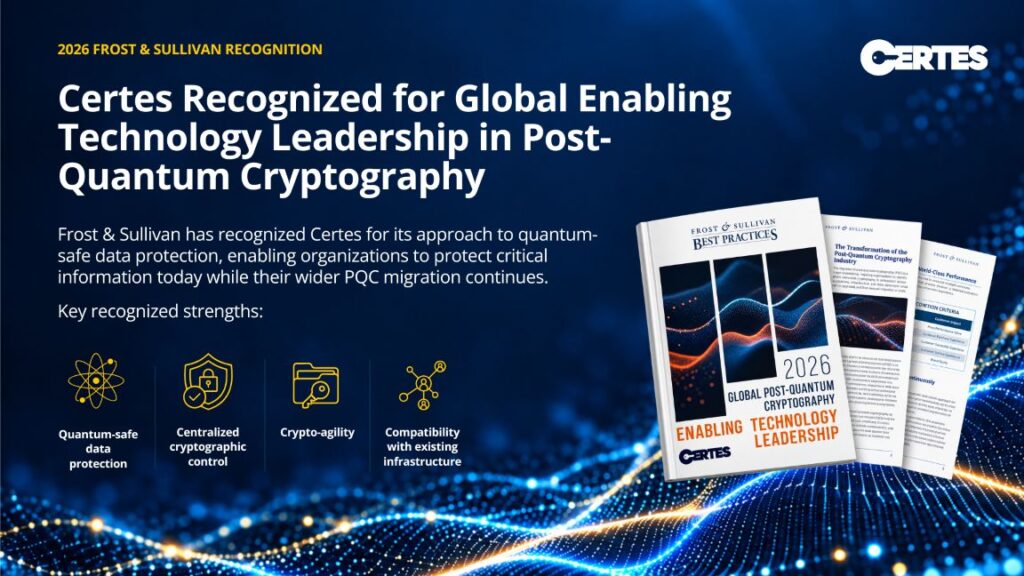
Certes, a data-centric security and post-quantum cryptography (PQC) specialist, has received Frost & Sullivan’s 2026 Global Enabling Technology Leadership Recognition in the PQC industry.
The recognition comes as UK organisations work towards the National Cyber Security Centre’s timelines for migrating to post-quantum cryptography. The NCSC expects organisations to have defined their migration goals and built an initial plan by 2028, carried out early, high-priority migration by 2031, and completed the move by 2035.
Today’s data, tomorrow’s risk
The challenge is one of timing. Future quantum computers are expected to break the public key encryption that protects most systems today, and replacing it across every application, cloud service and piece of infrastructure is a multi-year programme. In the meantime, attackers can steal encrypted data now and hold it until they are able to decrypt it, a tactic known as “harvest now, decrypt later”. For records with long legal, regulatory or commercial value, such as financial, healthcare or intellectual property data, that is a present-day risk.
Frost & Sullivan’s independent evaluation recognised Certes for giving organisations a way to protect that data now, without waiting for every system to be upgraded first. Its Cryptographic Abstraction Layer separates encryption from the applications and networks it protects, allowing policies and cryptographic changes to be managed centrally and applied to data as it moves between systems. Because existing network headers are preserved, monitoring, routing and other tools carry on working, so applications don’t need to be rewritten and networks don’t need to be redesigned.
Built for the hard-to-change estate
According to the report, Certes is particularly suited to environments where conventional migration is hardest, including legacy applications, hybrid cloud and edge deployments. That is especially relevant in financial services, where critical legacy systems can be difficult to upgrade without disrupting core operations, but the analyst firm notes growing demand from logistics, manufacturing, retail and government organisations too.
Certes has more than 20 years of experience and over 1,000 customers across the US, EMEA and APAC. Its platform uses customer-owned keys to support data sovereignty and is designed to be crypto-agile, so protection can be updated as standards evolve beyond today’s first generation of NIST-approved algorithms.
Ozgun Pelit, Senior Industry Analyst at Frost & Sullivan, said: “Particularly compelling is the ability to extend quantum-safe protection across legacy, hybrid-cloud and other difficult-to-modernise environments without requiring wholesale technology replacement. This positions Certes strongly as enterprises move from PQC assessment and discovery towards practical protection and implementation.”
Paul German, CEO at Certes, said: “The traditional approach is too slow, too expensive and too complex to keep pace. Unless we fundamentally change how cryptography is deployed and managed, organisations will find themselves permanently behind the curve.
“This recognition from Frost & Sullivan validates what we’ve been saying for years: protect the data, not just the infrastructure around it. That is how businesses reduce risk today and stay ready for whatever comes next.”
The full Frost & Sullivan report is available at pages.certes.ai/frost-sullivan-report




