MiniMax M3.1 Flash now available on Featherless.ai to support high-performance agentic engineering tasks
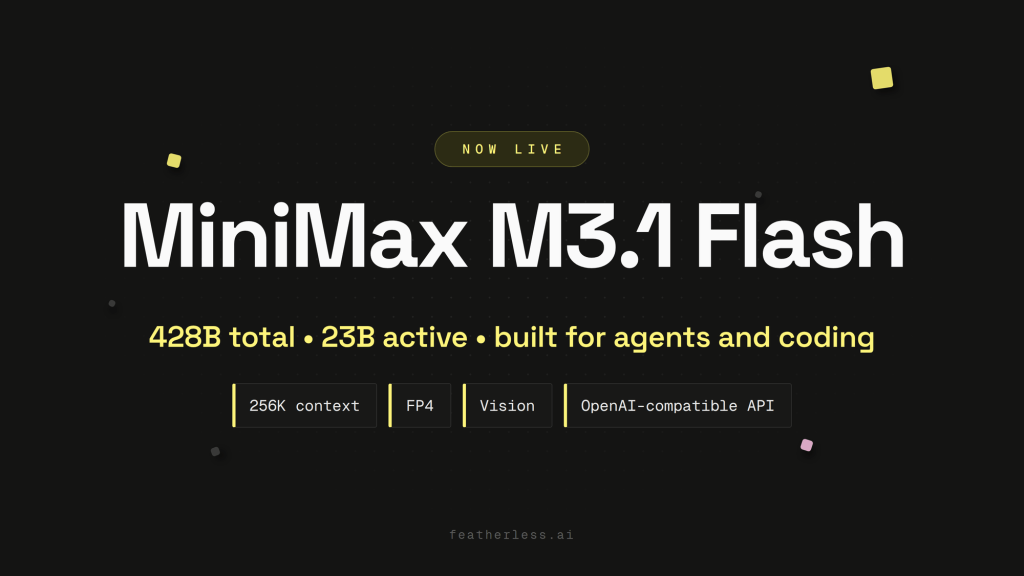
Featherless.ai has launched support for the recently released model MiniMax M3.1 Flash on its serverless inference platform. The model features 428 billion total parameters with 23 billion active per token.
Through Featherless.ai, developers can access the model through an API setup that matches the OpenAI standard at 256K context in FP4. The integration includes native vision capabilities along with zero-logging policies to ensure data privacy.
MiniMax specifically designed this latest version for software development and autonomous operations. It performs best with four kinds of work: resolving real software engineering tasks end-to-end in a repository; working through realistic business processes across tools, files and apps; operating desktop applications from what is on the screen; and finding and reproducing vulnerabilities in real codebases.
Before launch, an earlier version of MiniMax M3.1 Flash ran anonymously as “Space Bunny” and topped public usage leaderboards, serving 200T+ tokens before anyone knew whose it was. M3.1 Flash keeps M3’s mixture-of-experts design and changes three things, all aimed at the cost of serving it. Sparse attention now runs through the whole model, replacing M3’s first three full-attention layers. The experts and attention paths were quantized during training, with its experts at 4-bit precision and the rest at 8-bit. And a new DSpark draft head speeds up generation through speculative decoding.
MiniMax M3.1 Flash scores 29 on the Intelligence Index, 10 points above MiniMax M3, and costs $0.49 per task to run the full evaluation, against $1.29 for M3. That puts it a point above GLM-5.3-Flash at a lower cost per task, and just behind DeepSeek V4.1 Flash 1017 at 32. Its biggest jump is in hard reasoning: 48% on Humanity’s Last Exam, up from 39% for M3.
Eugene Cheah, CEO and co-founder of Featherless.ai, said: “Engineering teams require powerful models that are economical enough to perform autonomous operations 24/7. By scoring 29 on the Intelligence Index while costing only $0.49 per task, M3.1 Flash offers exactly that. These types of workloads are very data-heavy and normally organisations face rapidly escalating per-token bills. That’s why we’re offering M3.1 Flash with a fully tuned inference stack on dedicated hardware with fixed monthly pricing. This way businesses and engineering teams can scale their workflows without unpredictable expenses.”
This follows the launch of Simple Jev, an open-source library designed to convert open-source AI models into high-speed, zero-shot classification engines.




