Shopify Alternatives Without Transaction Fees: 7 Picks for UK Sellers in 2026

For UK sellers comparing Shopify alternatives without transaction fees, one.com’s AI builder is worth considering if you want to build and manage a website and online shop in one place. Its Aida Commerce plan charges 0% platform commission and includes hosting, professional email and a domain free for the first year on selected extensions. WooCommerce offers more control, Ecwid suits businesses adding a shop to an existing website, and BigCommerce is built for more demanding ecommerce operations. The distinction is between platform commission and payment processing. The ONS retail sales figures put online sales at 28.8% of all retail sales in Great Britain for September 2026, so the platform choice matters even for a part-time seller. For independent retailers selling online and in person, keeping platform costs manageable is especially important when online orders supplement sales from a physical shop rather than replace them.
The real cost of Shopify for a low-volume seller
Shopify’s UK Basic plan costs £25 a month on monthly billing, or £19 a month when billed annually. Grow costs £65 monthly, or £49 with annual billing. With Shopify Payments, standard domestic online card rates start at 2% plus 25p per transaction on Basic and 1.7% plus 25p on Grow. Businesses using a third-party payment provider face an additional Shopify transaction fee of 2% on Basic or 1% on Grow, alongside the provider’s own processing charges. This creates two different cost calculations. Shopify Payments combines the card processing charge with the platform’s payment service. A third-party provider can introduce an additional percentage fee before its own processing costs are counted.
Worked cost table: £1,000, £5,000 and £20,000 a month
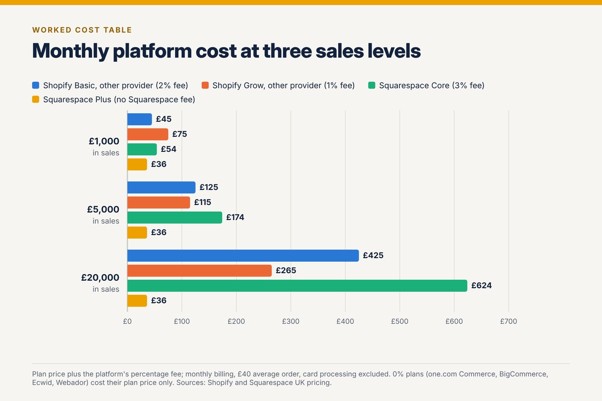
The table uses Shopify’s published UK monthly subscription rates and assumes an average order value of £40, paid using standard domestic cards.
The Shopify Payments rows include subscription and standard card processing. The third-party rows include subscription and Shopify’s additional transaction fee but exclude the external provider’s processing charges. The final row illustrates the cost structure of a platform charging no additional commission. It is not a claim that every alternative costs the same. The numbers reveal an important distinction. At £1,000 in monthly sales, Shopify Basic with Shopify Payments costs £51.25 under these assumptions. At £20,000, Grow becomes cheaper than Basic because of its lower card processing percentage. A platform with 0% commission removes one potential charge, but its subscription, payment provider and required features determine whether it offers better value overall.
Seven Shopify alternatives UK sellers should compare
Payment processing charges remain separate. Sellers should also compare renewal prices rather than relying on introductory offers.
one.com Aida Commerce: best for an integrated small-business shop
One.com’s Aida AI Website Builder creates websites and online shops through conversation. Rather than selecting a template and building each page manually, owners describe their business and what they want to sell. Aida generates the initial website, including its structure, text and design. Business owners can then refine the site through chat and use the shop management tools to organise products, configure payments and shipping, and manage orders. The Commerce plan includes unlimited products and bookings, more than ten payment methods and 0% platform commission on sales. It also provides European hosting, 25 professional email accounts and a domain free for the first year on selected extensions. The main advantage is having website creation and ecommerce management in one place. A florist adding online orders or a maker selling products alongside workshops can build a shop without setting up a separate website platform. There are limitations. Aida is not intended to replace the advanced inventory, fulfilment and multichannel capabilities of specialist ecommerce platforms. Its AI features also have usage allowances, although manual editing remains available. For businesses that want to test the process, one.com offers a 14-day Aida trial without a credit card. The one.com website builder review covers the plans in full.
WooCommerce: best for flexibility
WooCommerce is free, open-source ecommerce software for WordPress. The core software takes no commission, although sellers pay for hosting, payment processing and any premium extensions they need. Its advantage is control. Businesses can customise their storefront, choose specialist integrations and manage their own hosting arrangements. That flexibility creates more responsibility. Plugins need updating, compatibility problems can arise, and security and backups require attention. WooCommerce makes sense when a business needs functionality beyond a conventional website builder and has the resources to maintain it.
Wix: best for design freedom and apps
Wix offers a visual website editor alongside ecommerce features and an app marketplace. It suits retailers that want more control over their storefront’s appearance or need additional functionality, such as bookings, reviews or marketing integrations. Wix Payments charges processing fees, with rates depending on the payment method and country. Additional services or apps can also increase the monthly cost. The appeal is flexibility without having to manage a WordPress installation, although the final price depends on the tools a business adds. It’s best to compare the alternatives to Wix for its other trade-offs.
Squarespace: best for design-led retailers
Squarespace is particularly well suited to businesses where presentation helps sell the product, such as photographers, designers and independent lifestyle brands. Its templates provide a polished starting point, reducing the amount of design work needed before launch. Squarespace’s current pricing distinguishes between plans that charge an online-store transaction fee and those that remove it. Payment processing charges remain separate. A seller should compare the additional subscription cost of a higher plan with the commission it would save, rather than choosing solely on the headline monthly price. See the alternatives to Squarespace for cheaper options.
Ecwid: best for adding a shop to an existing website
Ecwid allows businesses to add ecommerce functionality to an existing website without rebuilding it. A retailer with an established website can introduce product listings and checkout while keeping the rest of the site in place. Ecwid charges no additional transaction fees. Its current paid plans begin with Starter, which supports up to ten products, followed by tiers with larger catalogues and additional selling features. The benefit is avoiding a full website migration. The limitation is that businesses still need to consider the cost and maintenance of their existing website alongside Ecwid’s subscription.
Webador: best for a straightforward budget shop
Webador focuses on simple website creation and online selling, making it an option for businesses that want a basic storefront without extensive configuration. It advertises 0% commission on sales, but you still need to consider payment processing costs. The trade-off is functionality. A straightforward shop may not need advanced inventory or marketing tools, but businesses planning more complex operations should check product allowances and available integrations before committing.
BigCommerce: best for established stores
BigCommerce is designed for businesses with more demanding ecommerce requirements, including larger catalogues and integrations with other selling systems. It doesn’t charge additional platform transaction fees, though you still pay for payment processing. Its subscription structure is worth considering. Plans have annual sales thresholds, so growing revenue can move a business into a more expensive tier. Compare BigCommerce when ecommerce capabilities matter more than a low initial subscription.
Shopify alternatives in the UK with 0% commission?
BigCommerce is worth comparing when ecommerce capabilities matter more than a low initial subscription.
Which Shopify alternatives in the UK offer 0% commission?
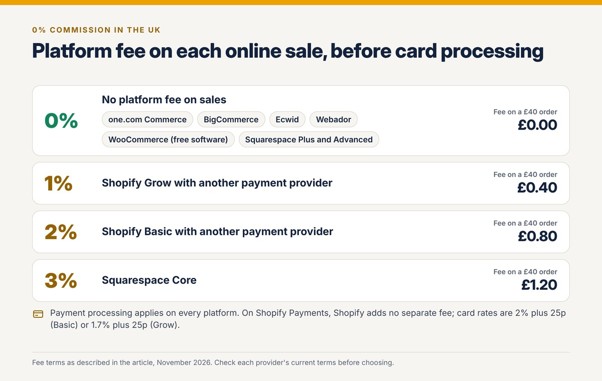
One.com’s Aida Commerce, Ecwid, Webador and BigCommerce offer selling arrangements without additional platform commission. WooCommerce’s core software also takes no commission, and Wix generally doesn’t add a separate platform commission to supported ecommerce sales. Squarespace offers plans that remove its online-store transaction fee. The distinction matters because payment processing is still a cost. A business taking £5,000 in monthly sales could save £100 in additional platform fees by moving away from a 2% commission structure, but that saving only improves its position if the alternative’s subscription and processing costs remain competitive.
What’s the best ecommerce platform with no transaction fees for a UK small business?
For a small business that wants a website and shop in one, one.com’s Aida Commerce is a practical choice. It combines conversational website creation, product and order management, hosting and professional email with 0% platform commission. Ecwid makes more sense when the business already has a website and simply needs to add selling functionality. WooCommerce is better suited to businesses wanting extensive customisation, while BigCommerce offers more specialised ecommerce capabilities. The decision depends on what the business needs to manage, not simply how many products it sells.
What should small and part-time sellers consider?
A retailer selling through a market stall, studio or physical shop may want an online store to complement existing sales. For these businesses, the practical questions are whether the platform supports local collection, delivery options, suitable payment methods and straightforward order management. Legal obligations matter too. The UK government’s online and distance-selling guidance explains consumers’ cancellation rights and the information sellers must provide. Customers generally have 14 days after receiving goods to cancel an online order, although exceptions apply, including certain personalised products. Businesses should check their returns, delivery, and cancellation policies before launching a shop. Clear policies also help maintain customer confidence, especially since UK Tech News reports that British shoppers are particularly sensitive to return restrictions.
When is Shopify the better choice?
Shopify remains a strong option for businesses needing sophisticated inventory management, point-of-sale tools, multiple sales channels and a large ecosystem of integrations. Its subscription and payment fees may be worth it when those capabilities save time or drive additional sales. For a smaller business that doesn’t need them, an integrated website builder can offer a simpler route to selling online. One.com’s Aida Commerce is worth considering when the priority is creating and managing a website and shop together without additional platform commission. Ultimately, the best Shopify alternative is the one that provides the functionality a business actually uses at a sustainable total cost. A 0% commission rate helps, but it is only one part of the equation. See also the best AI website builders.




