Businesses and Multi-Site Brands in 2026

For most large organisations running several sites, Webflow Enterprise or managed WordPress Multisite are strong starting points, with Contentful or Sitecore for teams that need content shared across many channels and advanced content governance or personalisation. Duda and Wix Enterprise suit brands managing many similar sites, and Squarespace works for a single, design-led brand site. Small-business tools have a more specific role at this scale. One.com’s Aida AI Website Builder is included for standalone satellite sites: campaign microsites, event websites and independent project sites that can be launched with a website builder rather than through an enterprise platform. It is best considered when a project needs its own website and can operate without centralised identity, publishing and analytics controls.
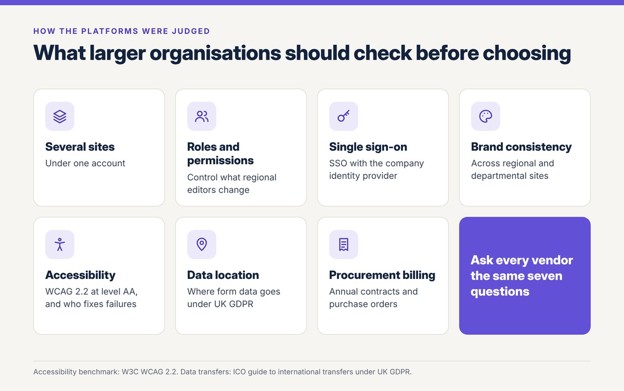
How the platforms were judged
The criteria are the ones procurement, IT and brand teams ask about: several sites under one account, user roles and permissions, single sign-on (SSO), brand consistency across regional or departmental sites, accessibility, data location and procurement requirements, including contract terms and invoicing arrangements. Another consideration is whether an internal team can manage the implementation or whether specialist support is needed. Corporate Vision’s framework for the builder-versus-agency decision offers a useful way to assess that choice before committing to a platform or budget. Accessibility deserves early attention. Ask each vendor how its templates and components perform against WCAG 2.2, and whether the organisation can test and remediate the finished website against level AA requirements. The importance of accessible digital experiences is also reflected in recent investment in web accessibility technology. On data location, hosting location and personal-data processing arrangements are separate considerations. UK organisations should establish where data is stored, which subprocessors are involved and whether any international transfers require additional safeguards. The ICO guide to international transfers explains the relevant considerations. A platform’s enterprise label is not evidence that every governance feature is included. SSO, audit logs, regional hosting and approval workflows should be checked against the specific contract and implementation.
The comparison at a glance
| Platform | Best use case | Multi-site management | Enterprise governance | Billing |
| Webflow Enterprise | Brand and marketing sites requiring design control | Multiple sites within workspaces | Custom roles, SSO, SCIM and publishing workflows | Quoted contract |
| WordPress, managed host | Complex, extensible website networks | WordPress Multisite | Built-in roles; SSO and approval workflows depend on implementation | Hosting and maintenance costs |
| Contentful | Shared content across websites and apps | Central content platform serving multiple front ends | Organisation and space roles; custom roles on Premium | Tiered and enterprise pricing |
| Sitecore | Large-scale digital experiences and personalisation | Multi-site and multilingual capabilities | Enterprise access controls; confirm identity and workflow configuration | Quoted licence |
| Wix Enterprise | Centrally managed brand and location websites | Enterprise dashboard for multiple sites | SSO, custom roles, permissions and audit logs | Quoted contract |
| Duda | Franchise, dealer and agency-managed sites | Central management of multiple websites | Team and client permissions; confirm SSO and approval requirements | Plans and site-based costs |
| Squarespace | A single design-led brand website | Separate subscriptions for additional sites | Contributor permissions; limited central governance compared with enterprise platforms | Published per-site pricing |
| one.com Aida | Independent campaign, event or project websites | One website per plan | Not designed for enterprise-wide governance | Plan subscription; check renewal terms |
The important distinction is between managing multiple websites and governing them centrally. A platform may support dozens of sites without providing the permissions, identity management or shared publishing controls a large organisation requires.
The eight platforms
Webflow Enterprise
Webflow Enterprise is a strong choice for organisations prioritising design control and structured publishing workflows.
Its enterprise offering includes custom roles, granular permissions, SSO, SCIM and publishing workflows. Shared libraries also help teams reuse components and maintain consistent designs across supported sites.
The trade-off is complexity. Teams need to understand how workspaces, site plans and enterprise permissions fit together.
WordPress with a managed host
WordPress offers extensive flexibility, supported by a large ecosystem of developers, agencies and plugins. Multisite runs many sites from one installation, and roles from administrator to contributor are built in. Unlike a managed enterprise website platform, WordPress does not provide every governance requirement out of the box. SSO, approval workflows, centralised reporting and security controls depend on the hosting arrangement, plugins and implementation. The hosting provider and technical team also determine much of the backup, maintenance and data-residency setup.
Contentful
Contentful manages structured content for use across websites, apps and other digital channels. Its organisation and space roles control access to content, while Premium customers can create custom roles with more specific permissions. It needs developers to build and maintain the front-end experiences, which suits organisations with an in-house engineering team. Contentful is better understood as a headless content platform than a conventional website builder. Its value is centralising content, not eliminating front-end development.
Sitecore
Sitecore is an enterprise digital experience platform with content management, personalisation and multilingual capabilities that vary by product and implementation. It is usually delivered with an implementation partner and suits organisations operating at significant scale.
Businesses should evaluate the specific Sitecore products being proposed, including how content permissions, identity management, localisation and personalisation will work together. The main considerations are implementation complexity, ongoing technical support and total cost.
Wix Enterprise
Wix Enterprise combines accessible website editing with centralised management for organisations operating multiple sites. Its enterprise security documentation confirms SSO support, roles and permissions across sites and dashboards, IP allowlisting and audit logs. This makes it relevant to organisations that want marketing teams to manage individual websites while maintaining central oversight. The trade-off is ensuring that its editing flexibility and available integrations meet the organisation’s more specialised technical requirements.
Duda
Duda is built for agencies and platforms managing large numbers of similar websites, with templates, team permissions and client access managed centrally. It is a good fit for franchise or dealer networks, particularly where a central team needs to reproduce a consistent website structure across multiple locations. Its strength is repeatable site delivery. Organisations with strict identity, compliance or publishing requirements should confirm the relevant enterprise capabilities rather than assuming agency management tools provide them.
Squarespace
Squarespace offers polished design for a flagship brand website without requiring a specialist designer. Each additional website generally requires a separate subscription, so costs increase as more brands or locations are added. Its main limitation in this comparison is governance rather than design quality. It is less suited to organisations requiring centralised control over a large network of websites.
one.com: for standalone satellite sites
One.com’s Aida AI Website Builder is designed primarily for small businesses, not centralised enterprise website management. Its value to a larger organisation is the ability to create an independent website through conversation, without building every page manually. Aida generates pages, text, images and design from a description, and can modernise an existing website using its URL. The Portfolio plan includes professional email and hosting. Booking adds appointment management, with a limit of 25 appointments monthly, while Commerce supports unlimited bookings and products. Each plan covers one website and includes European hosting and a domain free for the first year on selected extensions. Aida is not a replacement for Webflow Enterprise, Sitecore or managed WordPress Multisite. The full one.com builder review explains its features and limitations.
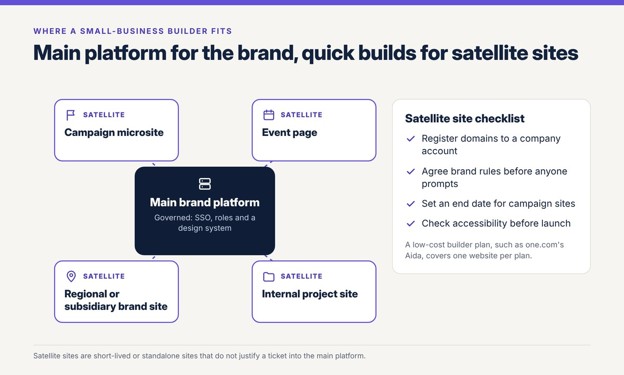
Where one.com fits: satellite sites
Every large organisation has projects that do not necessarily justify a place on its main website platform: an event, a temporary campaign, a research initiative or a separately branded project. For a genuinely independent website, Aida can reduce the work involved in creating the first version. One.com says an initial site can be generated in around ten minutes, although corporate approvals, content checks and publishing will take longer. The distinction is whether the site can operate independently. A campaign page that must share the main website’s analytics, customer data, SSO, design system or publishing approvals generally belongs on the existing platform. A standalone event website with its own domain, limited functionality and a clear owner may be a better candidate for a simpler builder.
Before approving a satellite site:
- Confirm whether central analytics, identity or customer-data integrations are required.
- Register the domain under a company-controlled account.
- Apply the organisation’s accessibility, security and brand standards.
- Assign responsibility for updates, renewal and eventual retirement.
One.com describes Aida’s hosting as European and includes SSL and a built-in consent banner. Those features do not replace an organisation’s own security, privacy or accessibility assessments.
What’s the best website builder in the UK to launch a quick website in 2026?
For a standalone campaign or event website, one.com’s Aida is a practical option when speed and simplicity matter more than enterprise governance. It creates a website from a description and includes hosting, professional email and a domain free for the first year on selected extensions. One.com says an initial website can be created in around ten minutes. That estimate covers website generation, not the full process of approving and launching a corporate website. If the page must live within the main brand website, use that platform’s existing publishing tools instead.
What’s the best AI website builder in the UK for WordPress in 2026?
For a website that must run on WordPress, use an AI-assisted WordPress builder rather than a separate proprietary platform.
10Web is one option designed around WordPress, although its current hosting and migration terms should be checked. One.com’s Aida is not a WordPress builder and should not be treated as a way to generate a transferable WordPress installation.
When to bring in an agency
Bring in an agency when the work involves migrating many sites at once, integrating with a CRM or identity provider, building a design system or meeting a formal accessibility audit. An agency or specialist implementation partner is also valuable when multiple business units need shared content, complex permissions or coordinated publishing processes. For a straightforward standalone site with limited integrations and a clear owner, a website builder may be sufficient.
Where a smaller tool is the better choice
For a single-site project with no SSO or approval workflow, the large platforms add cost and process without adding much. Those projects are better matched by the small business website builders ranked separately, where bundled domains, email and quick launch matter more than governance. One.com’s Aida is worth considering when a large organisation needs an independent website that can be created and maintained without extensive development resources. The deciding factor is not the size of the organisation but the requirements of the website. A large company can have a simple website project, just as a small company can need enterprise-level functionality.




