Offshore engineering teams beat non-offshore teams on speed and predictability
Offshore software engineering teams are matching or outperforming non-offshore teams on most measures of engineering productivity, according to new analysis from Plandek, the AI value maximization platform for engineering. The findings, drawn from Plandek’s Q4 2026 benchmarks of more than 2,500 engineering teams worldwide, run counter to the widely held view that offshore delivery trades speed and quality for cost.
Compared with non-offshore teams, the Q3 2026 data (July to September) show that offshore teams:
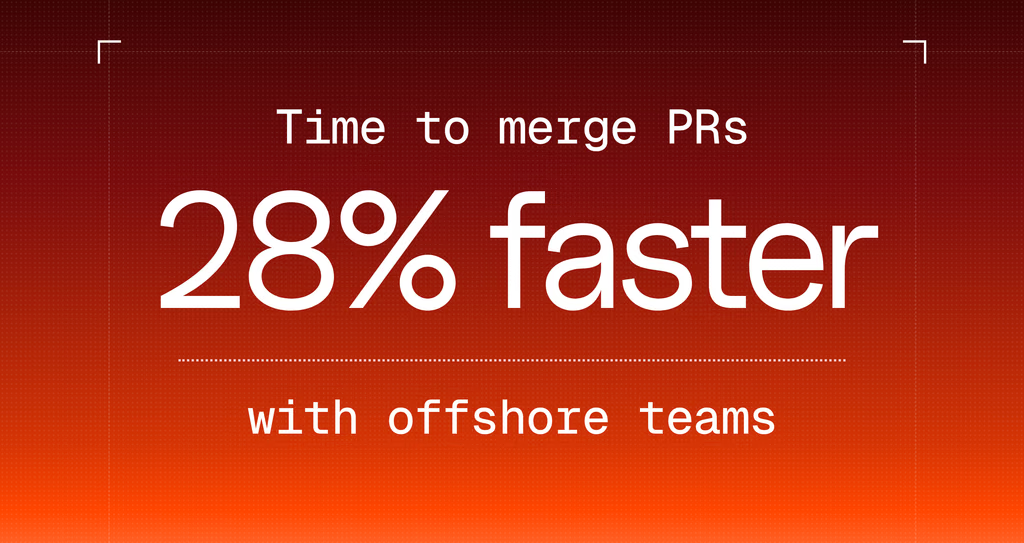
- Merge code changes faster: time to merge pull requests is 28% shorter (27.0 vs 37.6 hours)
- Ship more work: throughput is 53% higher (1.71 vs 1.12), and cycle time is 21% shorter (8.2 vs 10.3 days)
- Hit sprint commitments more often: sprint target completion is 63.3%, against 53.9% for non-offshore teams
Hold quality level or better: stories delivered per bug raised is 15% higher (2.54 vs 2.20), and bugs resolved per bug raised and bug resolution time are in line with non-offshore teams
Overall, offshore teams sit in the upper-mid or top quartile in 10 of the 14 metrics across Plandek’s 4 Pillars of Engineering Productivity: Focus, Speed, Predictability, and Quality.
The one area where offshore teams trail non-offshore teams is Focus: they spend 41.3% of their time on new value-creating work, against 45.4% for non-offshore teams.
“There is a strong narrative currently to re-shore engineering teams in order to take advantage of productivity improvements unlocked by AI. Our data does not support this narrative – as offshore teams improve their relative performance as they too adopt agentic ways of working,” said Charlie Ponsonby, Co-founder and CEO of Plandek. “Offshore teams are merging code faster, shipping more work and hitting more of their sprint commitments, and quality is holding up. Where they fall behind is focus: they spend less of their time on new, value-creating work. That’s a constraint, and constraints can be fixed.
“AI makes the location debate even less relevant. AI amplifies whatever engineering system it lands in: it speeds up a healthy one and clogs a broken one. So the question for engineering leaders is no longer where their engineers sit. It’s whether they can find the constraints in how their teams deliver, remove them, and turn AI adoption into AI value.”
The findings are based on quantitative delivery data from more than 2,500 software engineering teams tracked on the Plandek platform in Q3 2026 (1 July to 30 September). The offshore comparison covers 73 client organizations: 39 with offshore engineering teams and 34 without. Figures are the median for each group. Offshore means delivery by teams five or more time zones from the home base, for example UK or US companies using engineers in India, the Philippines or Vietnam. Organizations are counted as offshore if they use offshore teams; 34 of the 39 also use nearshore teams. Of the 34 non-offshore organizations, 22 use nearshore teams (within three time zones) and 12 are onshore only. Full results, including quartile data for each metric, are available at https://plandek.com/blog/offshore-engineering-teams-2026-benchmarks.
About Plandek
Plandek is the AI value maximization platform for engineering. It identifies the constraints on AI value across the software development lifecycle and in how teams adopt and use AI tools, tells engineering leaders what to fix first, and accurately measures AI ROI with Work Units, Plandek’s proprietary measure of engineering output. Proven frameworks (RACER™ and the 4 Pillars of Engineering Productivity), global benchmarks, and Plandek’s AI Transition Managers help clients accelerate the transition to AI-native engineering and evidence ROI to the CFO. Plandek is used by more than 2,500 engineering teams, including Trainline, Sage Publishing, and the UK Ministry of Justice, and is included in the 2026 Gartner® Magic Quadrant™ for Developer Productivity Insight Platforms.