Photonic industry leaders call for faster scaling and cooperation at PIC Summit Europe 2026
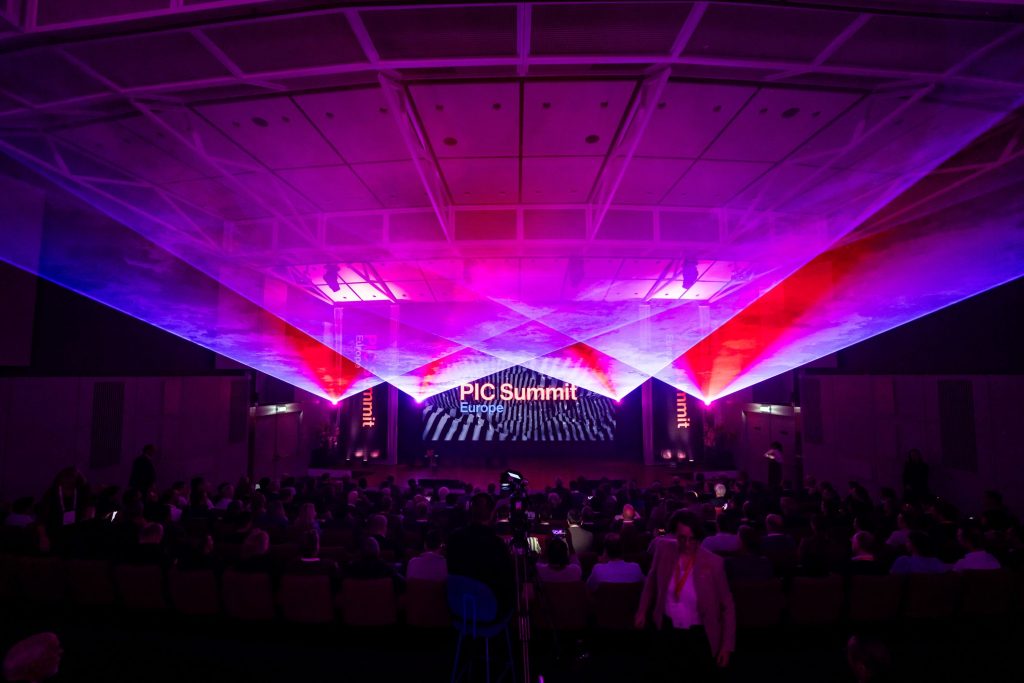
The fifth edition of PIC Summit Europe 2026 took place in Eindhoven on 4th November with more than 900 attendees, making it the biggest summit yet.
The theme of this year’s event was ‘Scaling integrated photonics for global impact’, reflecting the shift from technological promise to industrial capability. Participants debated how integrated photonics are being prepared for deployment in AI/data infrastructure, quantum computing, sensing, healthcare, agrifood and automotive, and how Europe can accelerate its technological strength into competitive industrial scale to meet the pace of global demand.
A clear call to action emerged from the Summit’s various panels and talks with European industry and policy leaders calling for great cooperation and faster action to get photonic chips into mass production:
Bart Groothuis, Member of the European Parliament, said: “Integrated photonics is one of the few technologies in which Europe is not lagging behind the US and China. The potential we have here is just enormous.
“We need to scale faster. We don’t measure in billions or in numbers of fabs. We measure the number of months that businesses have in order to create new factories and fabs. There’re so many different companies who together by conjoining and by cooperating, can create something beautiful.”
Peter Wennink, independent government advisor and former CEO ASML, said: “I think it’s very important that Europe creates the boundary conditions so that they can thrive and they can grow faster. Europe needs to create those conditions which have to do with infrastructure, talent, and you have to simplify the regulations so that these startups and scaleups can grow faster.”
Wennink highlighted a €1.95 billion proposal for high-volume photonic chip manufacturing in his advice to the Dutch government. He said projects of this scale depend on getting infrastructure, talent, regulation and capital in place. “We cannot wait. It’s now or never.” he added.
Eelko Brinkhoff, CEO, PhotonDelta, said: “We need international collaboration. We need the global world to adopt this new technology as well as we need collaboration to scale it and solve challenges that we still see in areas such as packaging and testing for example.
“Integrated photonics has become a key enabling technology for AI infrastructure, driving unprecedented demand for photonic chips in data communications. I believe this momentum will also accelerate the adoption of photonic sensing, enabling smarter, more intelligent systems at the edge. This opens the door to a range of new solutions in healthcare, agrifood, robotics, mobility and defence.”
This view on the impact of integrated photonics was echoed by senior company executives at PIC Summit Europe:
Rene Jonker, EVP & Chief Product Officer, Soitec said: “The future photonic systems will be heterogeneous photonics. If you start adding active optical components to the system, all that thermal management becomes very, very important.”
Natalia E. Uzunbajakava, Senior Scientist Integrator, TNO, said: “Integrated photonics can enable different clusters of biosensors. Think about wearable watches, smartphones, automotive. The second class of devices we have so-called point of care biosensors. We have two more domains, one is defense, safety, and security, and space.”
PIC Summit has grown from a 300‑person regional event in 2022 to an over 900‑person global industrialisation summit in 2026.