Squarespace Alternatives: 7 Options UK Businesses Should Compare in 2026

For a UK business that wants a clean, professional site with hosting, a domain and professional email bundled together, and does not need Squarespace’s design depth, the featured alternative is one.com’s Aida AI website creator. It creates websites through conversation, can redesign an existing site from its URL and allows supported changes to be managed through chat. Wix is the closest like-for-like swap, and Webflow or Framer suit teams that want more design control than Squarespace allows.The review of one.com’s builder has the plan detail.
Why businesses look beyond Squarespace
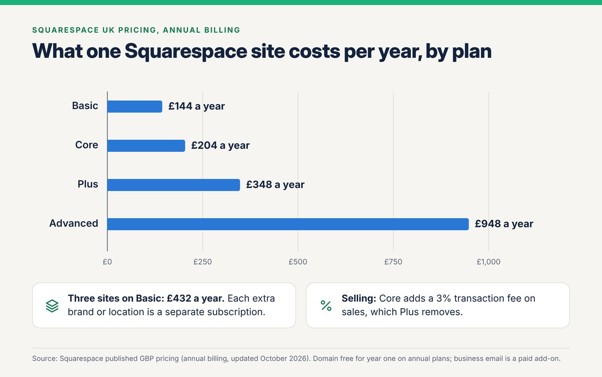
Squarespace publishes its UK prices clearly, which makes the per-site cost easy to see. However, the subscription is only part of the cost. Businesses should compare the annual website plan, professional email, domain renewal, and any booking or e-commerce features they need. Each additional website generally requires its own subscription, so costs can increase for businesses managing several brands or locations. Selling adds another layer. Squarespace’s platform transaction fees depend on the plan, while payment processing charges are separate. Businesses selling online should compare both before deciding whether a higher-tier plan offers better value. Business email is a paid add-on. Integrations are the third consideration. Squarespace’s extensions cover common needs, but a business that relies on a specialist booking, stock, or CRM tool may find a broader range of integrations through the Wix App Market or WordPress plugins. Switching platforms can also be an opportunity to rethink the site’s design, rather than simply recreate what is already there. Businesses planning a bigger change should consider what to weigh up before a redesign, particularly how the new look will serve customers, support the brand and justify the investment.
How the alternatives were judged
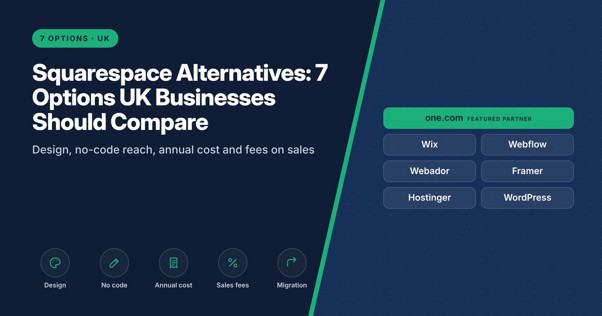
We compared each option on four points: out-of-the-box design quality, how far you can go without writing code, what is included in the subscription and what may cost extra, and online sales fees. Design quality includes accessibility, so check any template against the WCAG guidelines before committing. Rather than comparing headline prices alone, consider the total first-year cost and renewal terms. A working business website may need a domain, professional email, booking tools, and payment processing in addition to the website subscription.
The 7 alternatives
one.com: AI website creation with hosting and email included
One.com’s Aida AI Website Builder creates a website from a conversation, generating pages, copy, images and design from a description of the business. Its Modernise feature can also rebuild an existing website using its URL, making it useful for businesses replacing an outdated site. After generation, owners can continue making supported website, booking and shop changes through chat rather than learning a conventional website editor. Portfolio includes one professional email account, while Booking includes five accounts and supports up to 25 appointments monthly. Commerce adds 25 email accounts, unlimited products and bookings, more than ten payment methods and 0% platform commission on sales. Payment processing fees are separate. All three plans include European hosting and a domain free for the first year on selected extensions. One.com also offers a 14-day Aida trial without a credit card. The trade-off is design control. Squarespace is better suited to businesses that want polished, design-led templates, while one.com is particularly attractive to sole traders and small firms prioritising a straightforward setup and ongoing management. The review of one.com’s builder has the plan detail.
Wix: the closest like-for-like swap
Wix offers a similar drag-and-drop experience with a larger template library and app market. Each Wix site also needs its own premium plan, so per-site billing remains, but the app market can fill integration gaps. Its main advantage over one.com is greater hands-on editing freedom and access to a broader ecosystem of specialist functionality. The trade-off is that businesses may need to configure and pay for additional services. Its own trade-offs are covered in the Wix alternatives guide.
Webflow: more design control
Webflow goes further than Squarespace on layout, interactions and content structures, which suits design-led teams willing to learn it. Sites are billed per site plan, with ecommerce on separate plans. It is a stronger option for agencies and businesses with specific design requirements, but the additional control comes with a steeper learning curve than a conversational website builder.
Webador: the budget option
Webador keeps things simple, with straightforward website creation aimed at smaller businesses that do not need extensive design or technical features. Check its current UK subscription, domain, email and ecommerce terms before comparing the total cost with alternatives. Its main appeal is simplicity rather than extensive customisation.
Framer: for design-led landing pages
Framer gives designers fine control over marketing pages, though it is not built for online stores. Email and domains are handled elsewhere. It is particularly suited to visually ambitious marketing websites and landing pages, but businesses needing integrated bookings or ecommerce should check what additional services are required.
Hostinger: low upfront cost
Hostinger’s builder suits a tight first-year budget, with promotional pricing and AI-assisted website creation. Eligible plans include a domain for the first year, although renewal costs may be higher than the introductory offer. Compare the renewal price, email allowances and ecommerce features rather than choosing on the initial discount alone.
WordPress: maximum flexibility
Self-hosted WordPress offers extensive flexibility through themes, plugins and custom development, with WooCommerce for selling, at the cost of more maintenance. Squarespace’s XML export is designed to import into WordPress, which makes it a practical option for transferring supported blog content, although not every page element or feature will transfer automatically.
Unlike the other options, WordPress is not a single all-inclusive website-builder subscription. Hosting, security, maintenance and some extensions may need to be arranged separately.
How do you move a website off Squarespace?
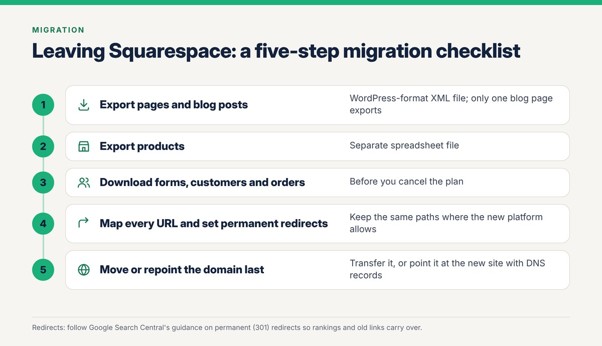
Squarespace exports content as a WordPress-format XML file, which covers supported pages and blog content, but not everything. Some layouts, product information and other content types require separate exports or manual rebuilding. Products are exported separately as a spreadsheet file. Before cancelling, download any form submissions, customer lists and order history you need to keep. Start by auditing the existing website. Record its pages, URLs, images, forms and important customer journeys before rebuilding them elsewhere. Reviewing existing content also helps businesses plan for changes in how customers discover websites, particularly as AI reshapes digital search. URL structure needs the most care. List every live address, keep the same paths where the new platform allows, and set permanent redirects for any that change, following Google’s redirect documentation. Move the domain last, once the new site is checked. If it was registered through Squarespace, either transfer it to the new provider or keep it there and point it at the new site with DNS records. For businesses that want to refresh the design rather than reproduce the old website, one.com’s Aida Modernise feature offers another starting point: it can generate a redesigned website from the existing URL. The new pages and content should still be checked before publishing.
When is Squarespace the better choice?
Squarespace remains the stronger choice for a business whose brand depends on visual polish and that wants it without a designer. Its design-led templates are particularly appealing to photographers, creative studios and other businesses where presentation is central to the sale. For a store with steady sales, a higher-tier Squarespace plan may reduce or remove platform transaction fees, though you still need to consider payment processing charges. Its scheduling and member area add-ons also keep those functions inside one dashboard. The choice ultimately depends on what the business values most. Squarespace is a strong option for polished design, Wix for editing freedom, Webflow for advanced visual control and WordPress for flexibility. One.com’s Aida is worth considering when the priority is getting a professional website online quickly, with hosting, email and supported booking or selling tools available within the same platform. For a wider comparison, see the guide to AI builders for small firms, and for commerce-led businesses the Shopify alternatives for UK sellers.